
close
close
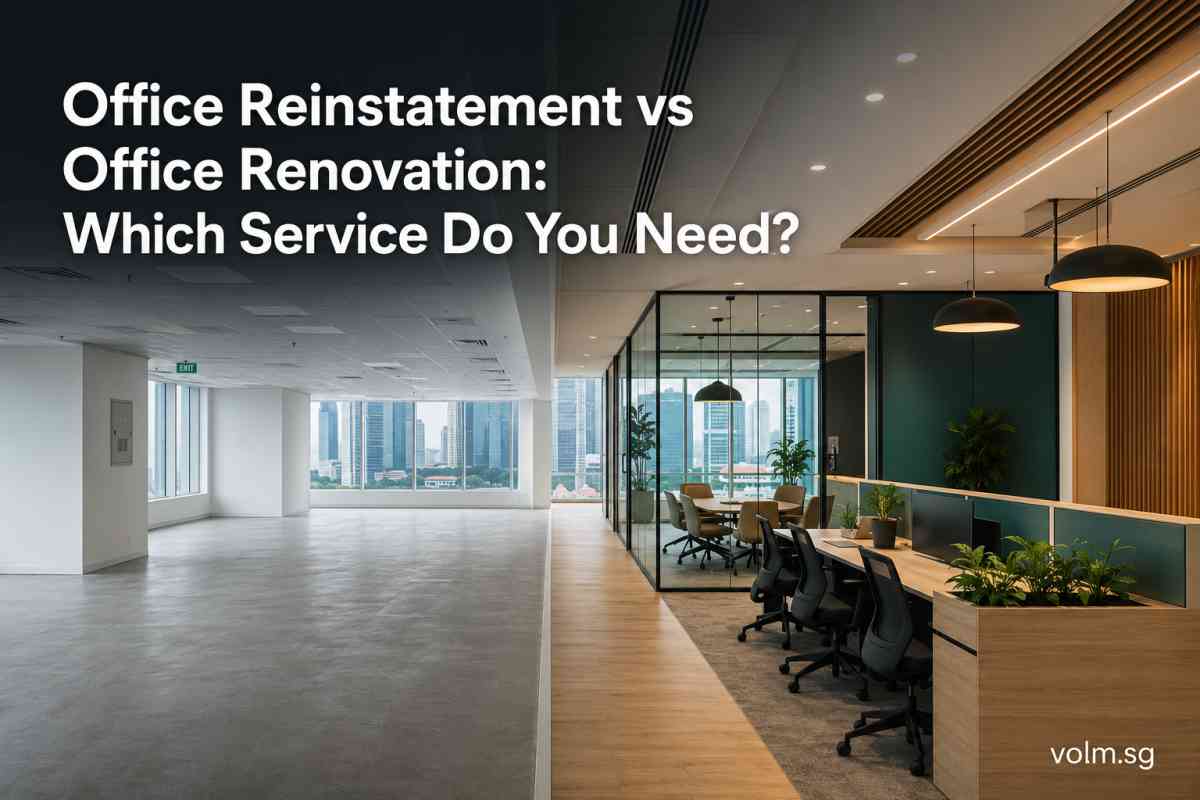
Office reinstatement returns a leased space to its original condition for landlord handover, while office renovation transforms and upgrades it to meet the business’s operational needs.
Reinstatement is typically mandatory at lease end, whilst renovation is voluntary and driven by operational requirements.
For businesses and tenants in Singapore, especially those approaching lease expiry or planning workspace upgrades, the distinction affects compliance, budgeting, project scope and timing.
Below is a practical comparison of office reinstatement and office renovation, including their purposes, costs, risks, and factors to help you choose the right service based on your lease status and business objectives.
Office reinstatement and office renovation are opposite processes. Reinstatement removes every tenant improvement - partitions, flooring, lighting fixtures, false ceilings, built-in joinery and signage - to restore the commercial unit to the condition it was in when the lease began.
Renovation adds and upgrades a space to fit business needs, from layout redesign and meeting rooms to MEP enhancements and brand identity features.
The key differences come down to obligation versus choice:
Office reinstatement is compliance-driven. Most commercial leases in Singapore include reinstatement clauses that require tenants to return the premises to their original condition before handover. The work is defined by the tenancy agreement and landlord expectations.
Office renovation is improvement-focused. It is initiated by the tenant to enhance functionality, appearance or operational efficiency. The scope is defined by business needs, not lease requirements.
Both processes involve distinct goals, timing, and outcomes - and both involve construction work. Understanding the distinctions between reinstatement and renovation helps businesses budget appropriately and plan each project with the right contractor.
The fundamental goals of reinstatement and renovation sit at opposite ends of the commercial property lifecycle. One is about returning a space; the other is about making a space work harder.
The primary purpose of office reinstatement is commercial reinstatement in line with the legal requirements of the tenancy agreement. Most Singapore leases include a reinstatement clause, and the obligation falls squarely on the tenant.
Reinstatement focuses on meeting the landlord's handover checklist: removing all tenant-installed modifications, restoring mechanical systems, fire safety infrastructure, electrical wiring and power points to their original configuration, and ensuring surfaces are made good.
Proper reinstatement helps avoid disputes and deductions from the security deposit, and understanding lease agreements helps define the handover scope more clearly.
Delays or incomplete work can result in extended rental costs, the landlord appointing their own contractors at the tenant's expense, or outright forfeiture of the deposit.
Reinstatement is essential for maintaining good relations with property managers - something that matters if you need references for future commercial leases. For many commercial tenants, completing the work before the lease expires is essential to ensure a successful handover.
The primary goal of renovation is to enhance functionality and appearance. Office renovations can improve employee morale and project a professional image, making the workspace a genuine asset rather than just a location.
Renovation typically happens before moving into a new office or during occupancy when business requirements change.
Businesses renovate to optimise space for growth or restructuring, create collaboration areas and quiet zones, integrate smart lighting and technology, strengthen brand identity, or prepare for hybrid working patterns.
Renovation focuses on redesigning the office layout to improve workplace efficiency - and the result is a customised and upgraded office space shaped around how your team actually works.
Unlike reinstatement, renovation is voluntary. It is driven by business strategy: attracting talent, supporting productivity, meeting ESG objectives, or simply making better use of an existing space.
Timeline pressures differ significantly between reinstatement and renovation - and misunderstanding these pressures is one of the most common causes of cost overruns and disputes.
Lease expiry is a fixed deadline. When your lease ends, the space must be returned, and the office reinstatement process must be completed before that date. There is typically no flexibility.
Reinstatement works typically take several weeks to complete. For small offices under 2,000 square feet, the work may take two to three weeks.
Mid-sized offices of 2,000–5,000 square feet generally require three to five weeks. Large offices or spaces with heavy MEP modifications and complex fire safety reinstatement can take six weeks or longer.
Tenants are commonly advised to begin planning three to four months before lease expiry. This allows time for site inspections, obtaining quotes, reviewing the original handover condition, and scheduling trades.
Early planning supports a smooth reinstatement process and helps keep the project stress-free. Delays risk extended rent liability, deposit forfeiture, or the landlord appointing contractors and charging the cost back to the tenant - often at a premium.
Coordination with building management adds another layer. Most buildings restrict noisy or disruptive work to specific hours, and the landlord or building management will conduct a final inspection before accepting handover.
Renovation scheduling is more flexible because it is driven by business needs and budget rather than a fixed contractual deadline.
A comprehensive office renovation - from design development through regulatory approvals, contractor procurement, construction work and handover - typically runs six to twelve weeks, depending on scale and specification.
For properties managed by JTC, plan consent and authority approvals alone can take up to twenty working days after lodgement, before any physical work begins.
The ability to phase work around business operations is a significant advantage. Many businesses stage renovations so that parts of the office remain functional during construction, reducing downtime.
Design, approvals and contractor selection can proceed in parallel with normal operations, and cash flow can be managed across phases.
Cost factors and budget planning differ substantially between reinstatement and renovation. Getting a clear picture of each helps avoid surprises.
Office reinstatement cost in Singapore typically ranges from $3 to $24 per square foot. Typical reinstatement costs range from $4 to $10 per square foot for straightforward scope - removing partitions, flooring finishes, restoring ceilings and capping electrical and plumbing points.
Small offices may incur reinstatement costs of a few thousand dollars, while larger units can incur significantly higher costs, particularly where extensive MEP work, fire safety systems, or specialist removals are involved.
Reinstatement costs in Singapore vary mainly with office size, scope of demolition and service restoration requirements. Reinstatement costs are typically the tenant's responsibility in Singapore. The main cost drivers include:
The extent and complexity of the original fit-out
Number of mechanical and electrical services affected
Whether after-hours or weekend work is required by building management
Disposal logistics for debris and removed materials
Hidden conditions revealed during demolition (damaged substrates, misaligned services behind panels or ceilings)
Once the scope is clearly defined through a site inspection, reinstatement cost becomes reasonably predictable.
The risk lies in scope items that are missed or underestimated - a low quote that omits making good finishes or restoring services may cause the final inspection to fail, adding cost and delay.
Renovation costs typically start from $30 per square foot for a basic refresh. Standard fit-outs with partitioning, meeting rooms, branded finishes and MEP modifications commonly fall in the $60–$180 per square foot range, depending on specification and building grade. Premium Grade A office projects can exceed these figures.
Variables that influence renovation cost include:
Design complexity and material quality (laminate versus veneer, vinyl versus hardwood)
Bespoke joinery and built-in furniture
Technology integration - AV systems, smart lighting, data cabling
MEP upgrades including air-conditioning, ventilation and electrical capacity
Sustainability features and certifications such as BCA Green Mark
Professional fees for architects, interior designers, MEP engineers and Qualified Persons
Regulatory submission and approval costs
Renovation budgets are scalable. A business can choose a basic refit or a comprehensive design-and-build project, adjusting scope to match available budget and priorities.
When both exit works and a new fit-out are required, using one contractor across both phases can improve cost efficiency.
| Aspect | Reinstatement | Renovation |
|---|---|---|
| Typical cost range (SGD/sq ft) | $3–$24, typically $4–$10 | From $30 for basic; $60–$180 for standard to premium |
| Primary cost drivers | Scope of original fit-out, MEP complexity, disposal, hidden conditions | Design, materials, technology, MEP upgrades, certifications |
| Budget predictability | Reasonably fixed once scope is defined | Variable; scalable based on specification choices |
| Who pays | Tenant (lease obligation) | Tenant (voluntary investment) |
Both reinstatement and renovation require regulatory compliance, but the nature and complexity of approvals differ.
Reinstatement compliance is mandatory and aims for full compliance with the tenancy agreement and building management requirements. The tenancy agreement defines the scope, and building management requirements govern how and when the work is carried out.
Most commercial leases specify the handover standard - often bare shell or the as-handed-over condition documented at lease commencement.
A proper reinstatement must satisfy:
Landlord or building management inspection - confirming the space matches the original handover condition
Fire safety standards - restoring sprinkler coverage, smoke detectors, fire-rated walls and doors to their original configuration, in accordance with SCDF requirements
BCA and structural compliance - if any structural elements were altered during the lease term
Handover documentation - approved as-built drawings, safety certifications, and completion sign-off
A qualified office reinstatement contractor also helps properly document the works and reduce handover issues.
Non-compliance can result in financial penalties, deposit withholding, legal disputes, or the landlord commissioning remedial works at the tenant's cost.
Having the original handover condition report, photographs and approved drawings is essential for determining what must be restored.
Renovation compliance involves a broader set of regulatory submissions to achieve full regulatory compliance, but the process allows greater flexibility to adjust plans during the approval phase.
Before any renovation work begins, tenants or their appointed Qualified Persons typically need to obtain:
Building management approval and plan consent from the landlord, with coordination with property management where required
URA planning permission if changes of use or external modifications are involved
FSSD approval for any works affecting fire safety systems
BCA plan submissions for structural or major building works under the Building Control Act
For HDB commercial premises, Addition & Alteration (A&A) works require Qualified Person endorsement and plan submission
Optional certifications such as BCA Green Mark can be pursued during renovation. Green Mark buildings have been shown to achieve substantial energy savings and potentially higher rental values - a consideration for businesses with ESG commitments.
The physical work involved in reinstatement and renovation differs fundamentally: one strips back, the other builds up.
Reinstatement work scope is defined by what was added during the lease period. Typical tasks include:
Dismantling tenant-installed partitions (gypsum board, glass, aluminium framing)
Removing flooring finishes - carpet tiles, vinyl, timber overlay
Restoring ceiling grids, tiles and lighting fixtures to original layout
Disconnecting and capping electrical wiring, power points and data outlets
Restoring air-conditioning diffuser positions, ducting and mechanical ventilation to original configuration
Removing built-in joinery, signage and branding elements
Making good all wall, floor and ceiling surfaces - patching, repainting, levelling
Disposing of all debris and cleared materials
Restoring fire safety infrastructure - sprinkler covers, smoke detectors, fire-rated doors
The focus is on achieving exact compliance with the original handover state. One common challenge is that make-good works after demolition often reveal hidden damage or service misalignments behind panels and above false ceilings.
These items are frequently underestimated and can add cost if not identified during the initial site inspection.
Office renovation upgrades a workspace for better functionality, and the scope is shaped by the business brief rather than a handover checklist. A typical renovation project may include:
Space planning and design development with interior designers or architects
Architectural finishes - flooring, ceiling treatments, wall cladding, paintwork
Partitioning for meeting rooms, quiet zones, collaborative areas and private offices
MEP upgrades - electrical capacity, air-conditioning zoning, data cabling, smart lighting
Built-in furniture and bespoke joinery
Technology and AV integration
Branding and signage installation
Acoustic treatment for open-plan or hybrid environments
Sustainability features - energy-efficient lighting, low-VOC materials, improved indoor air quality
Renovation typically results in a customised and upgraded office space. The scope is scalable: from a basic refresh of finishes to a full design-and-build transformation of the entire floor plate.
Both reinstatement projects and renovation projects carry risks, but the nature of those risks differs.
Reinstatement risks centre on time pressure and hidden scope:
The lease expiry deadline is immovable. Any delay in starting or completing the reinstatement process can trigger extended rental costs or deposit forfeiture.
Hidden conditions behind walls, above ceilings or beneath raised floors may only become apparent during demolition, increasing scope and cost.
Disputes over what constitutes the "original condition" arise when handover documentation is incomplete or ambiguous.
Building management restrictions on working hours can compress the available schedule.
Renovation risks tend to involve scope creep and regulatory delays:
Design changes mid-project are the most common source of cost overruns. Locking down the brief and specifications before construction begins is critical.
Regulatory and authority approvals - URA, FSSD, BCA, building management - can take longer than expected, particularly if submissions contain errors or missing documentation.
Business disruption during construction requires careful phasing, especially for large offices where teams continue to occupy parts of the space.
Material lead times and cost inflation, particularly for imported finishes or specialist items, can affect both budget and timeline.
Guidance on contractor selection applies to both: choose contractors with proven experience and licensing. Request a transparent quotation with detailed breakdowns - an itemised proposal makes it far easier to compare scope and identify omissions.
For handover-critical work, engage a professional reinstatement contractor to check quality and finish before final inspection.
If you are appointing an office reinstatement contractor Singapore, prioritise familiarity with local compliance standards, then check reviews and past project success.
A reliable contractor ensures timely project completion, whether the work involves stripping a space back or building it up.
The decision framework is straightforward once you identify where you sit in the lease cycle:
Choose reinstatement when your lease ends and landlord handover is required. In office reinstatement projects in Singapore, the space is returned to its original condition at lease end, and most Singapore leases include a reinstatement clause. The work is non-negotiable unless you reach an alternative agreement with your landlord in writing.
Choose renovation when you are improving an existing space or fitting out a new office to support business needs. Renovation can improve employee productivity and brand image, and it gives you the opportunity to rethink how your workspace supports day-to-day operations.
Many businesses need both. When relocating, you will typically need to reinstate your old office to satisfy lease requirements whilst simultaneously renovating your new space. Coordinating both projects requires careful project management - particularly around overlapping timelines, budget allocation and contractor scheduling.
Decision criteria to consider:
| Factor | Reinstatement | Renovation |
|---|---|---|
| Trigger | Lease expiry or early termination | Business decision or new lease commencement |
| Obligation | Mandatory under most commercial tenancy agreements | Voluntary |
| Outcome | Space returned to original condition for the next tenant | Customised workspace for your team |
| Timeline pressure | Fixed deadline | Flexible, business-driven |
| Budget nature | Cost of exit | Investment in operations |
Planning both services well in advance - ideally three to four months before any deadline - reduces the risk of rushed decisions, cost overruns and compromised outcomes.
If you are approaching a lease expiry or planning an office renovation, VOLM can help you understand the required scope, cost factors and timeline for your project.
To get started, share your premises type and size, building location, target completion or handover date, and any available floor plans or landlord checklists. We will provide a clear assessment of the work involved and practical next steps.
