
close
close
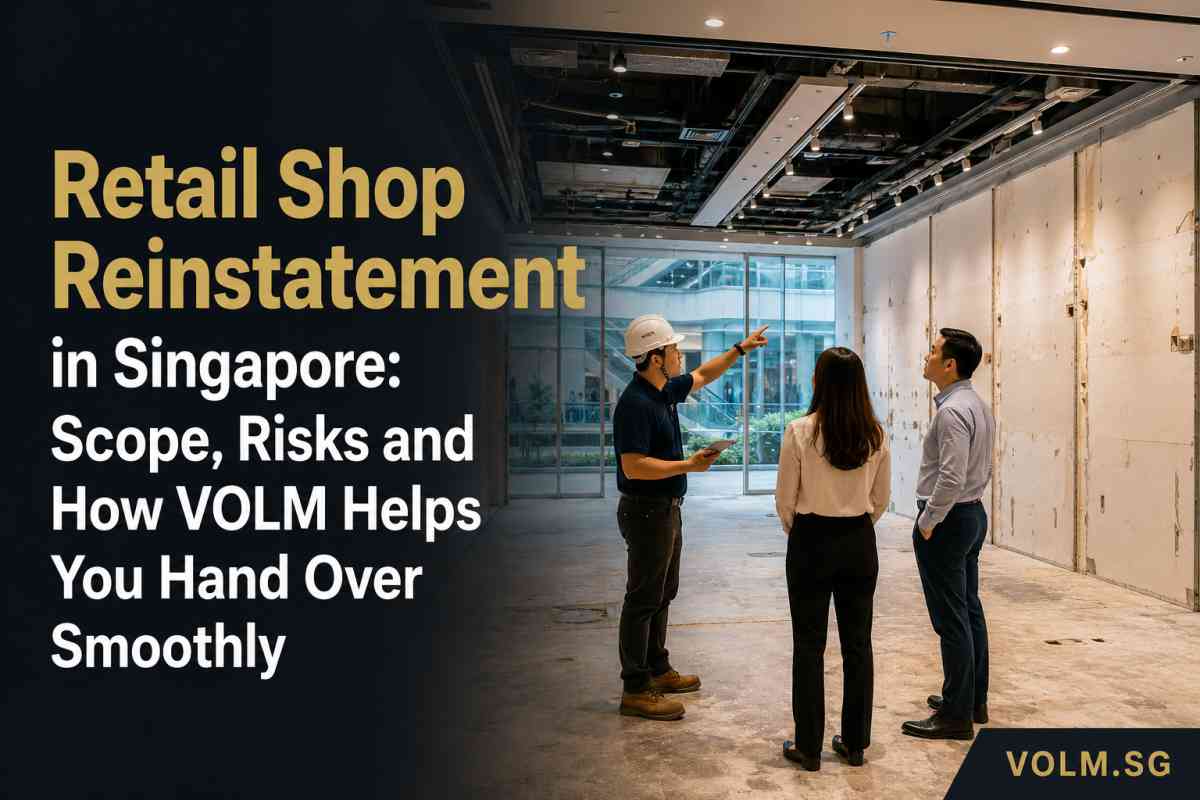
Retail shop reinstatement restores a leased commercial retail space to its original condition before the lease expiry date, as required by the reinstatement clause in your tenancy agreement. Failure to complete reinstatement can lead to forfeiture of your security deposit or landlord-imposed charges.
VOLM helps Singapore retail tenants scope, price and execute reinstatement work in time for final inspection and final handover - coordinating with the landlord, mall management and building management so handover proceeds without dispute.
This article focuses on practical planning for retail tenants in shopping mall units, shophouses and street-front shops, with comparisons to office spaces and industrial properties where relevant.
Retail shop reinstatement is a contractual obligation under commercial tenancy agreements requiring the tenant to restore the leased retail unit to the condition recorded in the original handover report. Reinstatement obligations are written into commercial tenancy agreements from the moment of signing, so tenants must confirm reinstatement requirements in their tenancy agreement well before lease expiry.
The reinstatement scope usually covers removal of all tenant fit-out elements - partition walls, built in displays, display units, false ceilings, custom flooring, signage structures and additional electrical installations. It also includes restoring walls, ceiling systems, flooring systems and data points to the landlord's baseline, plus thorough cleaning for final inspection.
These lease obligations apply to shops in malls, shophouses and ground-floor units in commercial buildings and mixed-use developments. The handover standard is typically "as per original handover report and photos," not a generic bare shell unless the lease agreement explicitly states otherwise. Tenants must restore premises to original shell condition before handover.
The most immediate consequence of incomplete shop reinstatement is financial. Landlords may charge tenants for incomplete reinstatement work, deducting costs from the security deposit - often at premium rates. Failure to complete reinstatement can lead to security deposit forfeiture. Beyond the deposit, tenants risk holding-over rent for every day the unit remains unaccepted after lease expiry.
Consider a mid-size retail shop on Orchard Road where the tenant neglects removal of added ACMV ductwork and a kitchen exhaust system. Mall management engages its own reinstatement contractor at after-hours rates, deducting costs from the deposit and charging holding-over rent until the unit is accepted. The total cost far exceeds what structured planning would have required.
Tenants are responsible for all reinstatement works, not contractors - meaning the legal and financial liability stays with you regardless of who performs the work. Delays may also strain brand relationships with landlords and mall operators, potentially affecting future lease negotiations.
Compared with office reinstatement, retail reinstatement typically involves stricter rules on façade restoration, signage removal, waste disposal and working-hour restrictions, making early planning even more critical.
"Original condition" is tenancy-specific. It is defined by your landlord's handover pack - drawings, specifications and baseline photographs - not by any universal standard. This is why documenting the current condition with photographs before reinstatement is essential.
Typical items include removal of custom shopfronts, signage structures (including mounting elements), display fixtures, partition walls and feature ceilings. Tenants must remove all custom installations before handover.
Extra plumbing, kitchen exhaust systems and beverage outlets equipment must be disconnected and removed. Restoration of surfaces involves patching walls and repainting to match the landlord's specified standard. Vinyl flooring, tiles and adhesive residue must be stripped, with flooring restoration completed to base finish.
The terms "bare shell," "fitted with basic finishes" and "as is where is" each carry different reinstatement scope implications. "Bare shell" means the landlord's original slab-and-services condition. "Fitted with basic finishes" may include standard flooring and lighting fixtures. "As is where is" usually limits work to removing tenant additions.
Pay attention to terminology in the reinstatement schedule: "remove" means dismantle and dispose; "make good" means repair damage to original condition; "reinstate" means return to specified finishes; "cap off services" means safely terminate redundant electrical wiring, plumbing restored to sealed state, or data connections. Misreading these terms is a leading cause of variation orders and unnecessary cost.
Many tenants with experience in office reinstatement underestimate the additional complexity that retail spaces introduce. Commercial properties often have limited working hours for demolition and noisy work, and malls impose stricter requirements than most office towers.
Retail units must comply with mall façade rules, shopfront glass removal standards, external signage regulations and public-area hoarding requirements. Noise limits, night-works scheduling and waste disposal logistics are more demanding. Mechanical systems and electrical systems in retail units often include tenant-added ACMV splits, kitchen exhaust and additional power points that require specialist disconnection.
Industrial properties bring different challenges: heavy-duty racking anchors, floor loading pads, epoxy coatings, mezzanine structures, and more extensive power and data points termination. Structural verification may be needed after removing heavy equipment bases.
Planning lead times and approval flows are usually longer in malls and some business parks than in standard office towers, making early engagement with your reinstatement contractor even more important.
A reinstatement schedule lists all required restoration tasks - every item the landlord or mall expects you to remove, reinstate or make good before they will accept the unit. Reinstatement schedules are issued 3 to 6 months before lease expiry in well-managed malls, though some arrive as late as four to six weeks prior. If yours has not arrived, request it proactively.
Reinstatement schedules can list up to 40 individual scope items. To manage them effectively, map each line to on-site conditions zone by zone - shopfront, sales floor, back-of-house, ceiling voids, service risers. Use a marked-up floor plan with timestamped photographs to track each item against what you observe.
Common confusion points include ACMV ductwork versus base building air-conditioning, DB board branches (remove or cap?), sprinkler head adjustments, floor platforms, and "remove vs make good" ambiguities. Landlord-retained items versus tenant-owned fixtures can also cause disputes.
Joint site inspections with the landlord are essential before starting reinstatement work. Seek written clarification on ambiguous items and record any agreed deviations from the formal schedule.
Time is the primary risk driver. Start reinstatement planning six to eight weeks before lease expiry for a typical 300–800 sq ft retail shop with moderate fit-out. Reinstatement typically takes six to eight weeks before lease expiry when you account for planning, approvals and execution. The reinstatement process typically spans 3 to 4 weeks of on-site work, but the surrounding administration adds several factors to the timeline.
Break it down: document review and initial assessment take one to two weeks. Quotation and contractor selection require another one to two weeks. Landlord and building management approvals - including permits for façade works, signage removal and ACMV disconnection - may take two to three weeks. On-site reinstatement work follows, then snagging and final inspection in the closing days.
Late schedule issuance can increase reinstatement costs significantly, forcing multi-shift or after-hours work at premium rates. If the schedule arrives late, consider negotiating a short extension, phased handover or accelerated works - each with cost implications.
VOLM helps balance business continuity with reinstatement deadlines, so you can keep trading as long as practical while meeting tight handover deadlines.
The actual reinstatement scope depends on several factors, including how heavily the retail unit was fitted out, but a core set of trades recurs across most shop reinstatement singapore projects.
Retail reinstatement involves removing tenant-installed fixtures and fittings, starting with protective hoarding where façade or glass removal is needed.
Partitions and display structures must be dismantled during reinstatement, along with built-in joinery, counters and shelving. Signage structures must be completely removed, including mounting elements and any façade lighting.
All tenant-installed electrical systems must be dismantled during reinstatement - additional circuits, lighting fixtures, power points and data cabling - with the DB board restored to the landlord's approved layout. ACMV additions and exhaust systems (particularly for food and beverage outlets) require specialist disconnection and sealing of ceiling penetrations.
Flooring installations must be removed to restore original surfaces: tenant-installed flooring, adhesive residue and screed damage all need attention. Plumbing must be restored to the original capped-off state, with water and gas points sealed.
Walls receive patching and repainting. Deep cleaning is necessary before the unit is presented for inspection, including thorough cleaning of all surfaces, floor traps and service areas. Construction waste must be disposed of according to regulations.
Office reinstatement and industrial reinstatement share some trades, but industrial may add heavy-duty slab repair or removal of machinery bases and racking anchors. VOLM prepares a complete reinstatement scope aligned with the reinstatement schedule and any mall or MCST guidelines to minimise surprises at final inspection.
Three main cost drivers shape every reinstatement project: direct reinstatement work (labour, materials, specialist trades), landlord-arranged rectification if you fail to complete the scope, and time-related holding costs after lease expiry.
Retail shop reinstatement costs can vary widely depending on unit size and fit-out complexity. Basic reinstatement costs range from $2,000 to $5,000 for lightly fitted units. Moderate reinstatement costs typically range from $5,000 to $12,000.
Comprehensive reinstatement costs can exceed $15,000 for heavily fitted or F&B spaces. At unit level, small retail units may cost between $5,000 and $15,000 to reinstate, while mid-size retail reinstatement typically costs $20,000 to $50,000.
When reinstatement goes wrong, the path is predictable: failed final inspection, a landlord's defect list, re-mobilisation of contractors, or the landlord appointing their own contractor and charging back at premium rates against the security deposit. Unexpected expenses compound quickly.
Indirect risks include senior staff time diverted to dispute resolution, reputational strain with building owners, and delays moving into a new location.
VOLM's role is to reduce these risks through careful site inspection, scope mapping and documentation - though no contractor can guarantee full deposit return, as that depends on meeting all lease requirements and the landlord's expectations.
Choosing the right contractor for retail shop reinstatement services goes beyond price. Access clearance, certifications and proven experience with retail environments are equally critical.
Look for a professional reinstatement contractor with demonstrated experience in shop reinstatement Singapore and similar mall-based projects. Engage a certified contractor with bizSAFE Level 3 certification, and verify relevant BCA registration where applicable.
Your contractor should demonstrate strong documentation practices - before, during and after photo reporting - and the ability to coordinate ACMV, electrical works and specialist trades under one programme.
Check whether the mall or landlord maintains an approved contractor list. Confirm Public Liability and Contractors' All Risks insurance thresholds, management requirements for Professional Engineer endorsement on structural or major ACMV modifications, and permitted working hours.
A site inspection before quoting is non-negotiable. Without walking the unit, hidden scope items in ceiling voids, behind walls or under flooring will be missed - leading to variations once work begins.
VOLM typically engages through an initial document review, a joint site walk, clarification of the reinstatement scope, and then issues a transparent quotation with inclusions, exclusions and assumptions clearly stated so you can compare options with confidence.
Here is how VOLM approaches a typical reinstatement project for Singapore retail units in malls and street-level locations.
The process starts with document and lease review - examining the lease agreement, handover pack, and any existing reinstatement schedule. Next, an on-site inspection captures data points: measurements, surface conditions, additional installations, and photographic records.
From there, VOLM prepares a reinstatement scope and budget plan, mapping each schedule item to the site and issuing an itemised quotation.
Landlord and building approval submissions follow - permit approvals may be necessary for demolition and utility disconnections. Loading and unloading of construction materials must be scheduled through the building's loading bay. Reinstating a retail shop requires adherence to lease agreements and building management rules throughout.
Once approvals are secured, on-site works proceed in logical trade sequence: strip-out and dismantling first, then services disconnection, followed by surface repairs, repainting and cleaning. VOLM coordinates with mall management for access permits, lift bookings, noisy-works windows and protection of common-area finishes.
Quality control includes photo documentation at each stage, zone-by-zone closure of schedule items, and a pre-inspection walk-through. The experienced team then supports the joint final inspection, presenting documentation to facilitate timely completion and acceptance.
While every reinstatement project differs, a methodical process reduces stress, variation orders and time pressure near the lease expiry date.
These are lessons from multiple Singapore retail and office reinstatement projects that consistently catch tenants off guard.
Underestimating the reinstatement scope. Tenants often focus on visible items - counters, signage - and overlook hidden elements in ceiling voids, electrical branches or exhaust flues. Mitigation: conduct an early site inspection referencing the handover pack and reinstatement schedule.
Ignoring ACMV, exhaust and fire-protection reinstatement. These require specialist trades and sometimes PE sign-off. Assuming the landlord will accept partial removal is risky. Clarify the acceptable standard in writing.
Starting too late. Waiting until close to lease expiry leaves insufficient time for approvals, snagging and rectification. Set internal milestones as soon as the schedule arrives.
Engaging contractors without mall access clearance. Using a reinstatement contractor not on the approved list can result in rejected work and delays. Verify clearance, insurance and certifications upfront.
Assuming small defects will be overlooked. Mall landlords inspect strictly. Even minor paint mismatches or unpatched holes generate defect lists. Carry out an internal pre-handover audit against the schedule.
For industrial properties, tenants sometimes forget to remove heavy racking anchors, cap redundant services, or repair floor slabs - leading to additional landlord claims. VOLM helps teams avoid these pitfalls through structured planning, though the tenant remains contractually responsible for compliance.
Handling reinstatement professionally protects your security deposit, avoids unnecessary downtime and closes your retail shop lease on clear commercial terms.
If you are relocating, reinstating a closed retail shop requires addressing both corporate restoration and physical property renewal - and if a business entity is legally dissolved, it must apply for restoration to resume operations at a new address.
When planning your move, evaluating demand for products is crucial when reopening a retail shop, and inventory logistics should be set up to manage stock from the previous closure. Successful reopening requires clear communication with customers and staff.
Marketing the reopening can include social media announcements and email blasts, and updating digital listings is essential to inform customers about reopening.
VOLM supports the full reinstatement process: clarifying the reinstatement scope from landlord documents, coordinating site inspection, advising on work sequencing, and preparing you for final inspection day.
To get started, share four details with us: your premises type (retail, office or industrial), unit size, building location and target completion or handover date. If you already have a floor plan or reinstatement schedule, include that too.
VOLM will provide a structured review and a clear, written proposal so you can handle reinstatement with full confidence in scope, cost and timeline.
Below are direct answers to questions tenants commonly ask when planning retail reinstatement or office reinstatement in Singapore.
Begin planning roughly eight to twelve weeks before your lease expiry date for a medium-sized retail shop. For food and beverage outlets or heavily fitted units, allow twelve to sixteen weeks. Early planning gives time for contractor quotes, landlord approvals and snagging - and avoids the cost premiums that come with rushed timelines. Inspecting the physical facility is crucial when reopening a retail shop after temporary closure at a new premises, so factor relocation logistics into your overall schedule.
Yes, some landlords waive or reduce reinstatement scope - for example, when the fit-out suits the next tenant or the landlord wishes to retain certain fixtures for a new tenant. However, any variation must be agreed in writing, ideally within the lease or a formal exit agreement. Without documented landlord consent, the full reinstatement clause remains enforceable.
The landlord will issue a defect or rectification list. You will need to re-mobilise contractors to address each item, potentially at after-hours or premium rates. If you have already vacated, the landlord may engage their own contractor and deduct costs from your security deposit. Holding-over rent may also apply until the unit is accepted.
You may, depending on scope. Structural alterations, removal of major ACMV or exhaust systems, and modifications to fire-safety or sprinkler systems typically require permits or Professional Engineer endorsement. Under the Lease Agreements for Retail Premises Act (LARPA) 2023, qualifying retail leases also have specific protections around security deposit caps and fair tenancy terms.
Renewing or obtaining required licenses and permits is often necessary for reopening at a new location. Your reinstatement contractor should flag required approvals early and include them in the project plan. Compliance with safety measures is important when reopening after a shutdown.