
close
close
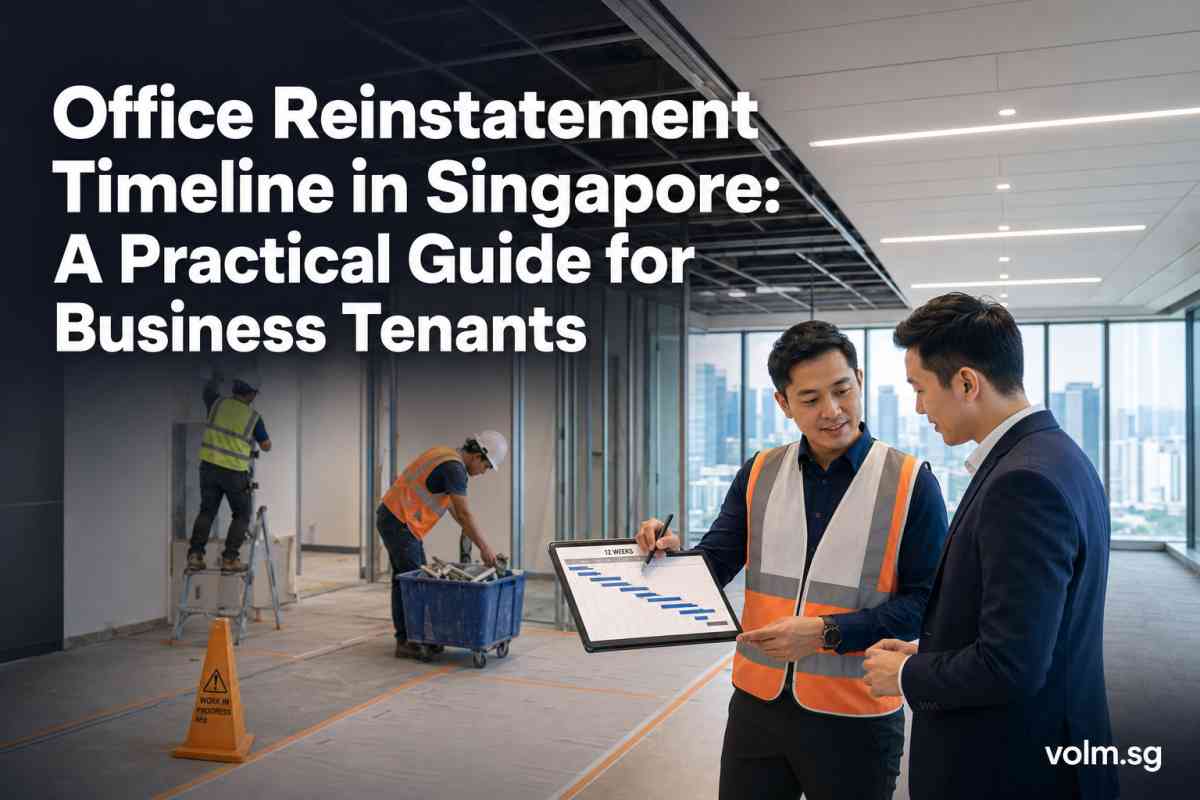
An office reinstatement timeline covers the full sequence from lease review and site inspection, through on-site reinstatement works, to final inspection and landlord handover.
For most Singapore offices, the entire process typically spans 8–12 weeks, with the physical work itself taking 2–8 weeks depending on office size, scope and building rules.
A realistic office reinstatement timeline in Singapore usually runs 8–12 weeks from the initial site inspection to final handover - not just the 2–4 weeks of on-site work that many tenants expect.
Approvals from the landlord and building management, plus move-out logistics and the final inspection, often control the schedule more than the physical demolition and painting.
Early planning - typically 3–6 months before lease expiry - protects against double rent charges, security deposit deductions and last-minute scope changes.
VOLM helps tenants map out the reinstatement programme, confirm the scope of work and identify critical approval dates before the pressure builds.
An office reinstatement timeline is the complete programme from reviewing your lease agreement and conducting a site inspection, through demolition and restoration works, to final cleaning, landlord inspection and key handover. It covers every stage - not just the days when contractors are on-site.
In Singapore, typical reinstatement timelines for standard CBD units sit around 8–12 weeks end-to-end.
If you are asking how long office reinstatement takes, office reinstatement Singapore projects usually involve 2 to 8 weeks of active on-site work, with the full process commonly taking 1 to 4 weeks or longer, only for very small or simple spaces, once approvals, documentation and defect rectification are considered.
Larger, heavily modified or Grade A offices may require 12–16 weeks once building management approval windows, restricted working hours and landlord expectations are factored in.
The rest of this article breaks the timeline into clear stages so you can map each phase against your own handover date.
The reinstatement timeline is not a purely technical programme - it directly affects your lease-end cash flow, security deposit recovery, business operations and office relocation plans.
Late reinstatement can incur double rent charges or penalties under the Civil Law Act, section 28(4), as confirmed in the recent High Court case Kwon Do Hyeong v Covenson Pte Ltd [2025].
A landlord may also appoint their own contractors to finish the work and deduct costs from your deposit.
Ignoring lease requirements can lead to costly rework if the landlord rejects the handover condition. Meanwhile, staff disruption increases when reinstatement clashes with move-out.
Many commercial buildings enforce strict building rules - limited hacking hours, service lift booking queues and fixed inspection dates - that are not negotiable.
A realistic, documented timeline helps internal stakeholders in finance, HR, IT and operations coordinate relocation, data cutover and asset removal with confidence rather than guesswork.
Several factors that affect project duration deserve attention well before work begins.
Office size and layout complexity. A simple open-plan office space clears faster than a unit with multiple rooms, built-in furniture, server rooms, raised flooring, or feature ceilings; the existing office layout also affects how much needs to be removed or restored during reinstatement.
Larger office spaces generally require more time for reinstatement than smaller ones because there is simply more to remove and restore.
Lease and reinstatement requirements. How "original condition" is defined in your tenancy agreement and commercial lease determines the scope of reinstatement. Some landlords insist on specific materials, paint colours or vendor lists.
Complex modifications increase both duration and cost of reinstatement - particularly where electrical and mechanical installations or fire safety systems must be reversed.
Building management and MCST rules. Noisy work windows, after-hours restrictions, lift-booking protocols, and waste-disposal routes all affect project duration.
HDB regulations may restrict working hours for reinstatement work, and many CBD towers impose similar controls.
Approval process and documentation. Insurance certificates, drawings, method statements and contractor credentials must be submitted before work begins.
Permit approvals can take 1 to 3 weeks, affecting costs and schedule. Contractor shortages often occur during peak periods like year-end, when many leases expire simultaneously.
Hidden defects. Once ceilings are opened or partitions removed, hidden issues discovered during reinstatement - such as water damage, abandoned cabling or non-compliant wiring - can require additional time to fix.
This chronological breakdown assumes a typical Singapore office of roughly 2,000–5,000 sqft, but you should check it against the remaining lease period before handover. For larger or heavily customised spaces, shift the programme earlier by 4–8 weeks.
12–10 weeks before handover. Review your lease agreement for reinstatement obligations and gather original fit-out drawings.
Document the office condition before renovations begin - photographs and the landlord's reinstatement checklist form the baseline. Request the office reinstatement checklist from your property manager and shortlist experienced contractors for site inspection.
10–8 weeks before handover. Conduct a detailed site inspection, confirm the scope of work covering demolition, M&E, finishes and fire protection, then obtain itemised quotations.
Common steps in the reinstatement process include site assessments and developing a reinstatement plan at this stage. Select a main reinstatement contractor and sign off on scope.
8–6 weeks before handover. The contractor prepares method statements, risk assessments and drawings for submission.
Obtain necessary permits before starting reinstatement work and coordinate with movers on office relocation dates. Building management approval is pursued in parallel. Engage a professional contractor now to ensure compliance and efficiency, not later.
6–3 weeks before handover. Reinstatement work starts in cleared zones. The sequence typically runs: dismantling and demolition, M&E reinstatement, ceiling and partition making good, then painting and restoring the flooring. Noisy works are scheduled within approved time slots.
3–1 weeks before handover. Bulk reinstatement tasks are completed. The contractor runs internal quality checks, resolves visible defects and prepares for the landlord's pre-inspection walkthrough.
Final week. Final cleaning, touch-ups and documentation collation (completion photos, safety certifications where required).
The reinstatement process includes a final inspection with the landlord to ensure compliance, followed by formal final handover of keys or access cards as per the tenancy agreement.
Start planning reinstatement at least two to three months before lease expiry - and ideally longer. Early planning gives you time to clarify grey areas in the lease, confirm office reinstatement requirements, obtain multiple quotations, secure your preferred reinstatement contractor and avoid peak-season bottlenecks.
As a guide by office size:
A small office under 2,000 sq ft with minimal modifications is often workable with an 8–10-week lead time.
A medium office of 2,000–5,000 sqft ideally needs 3–4 months.
Spaces above 5,000 sqft or multi-floor tenancies benefit from 4–6 months to allow for phased work and regulatory submissions.
Early planning also lets you align reinstatement timelines with office relocation, IT cutover and staff move-out - reducing expensive overtime and weekend works. Choose contractors with proven experience and strong local knowledge so that obtaining permits and managing landlord approval happen on schedule rather than reactively.
VOLM can conduct an early site inspection and a lease-based scope review to help tenants assess whether their current schedule is realistic.
These are typical ranges rather than fixed promises, and the time required for office reinstatement in Singapore depends on the office's size and complexity. Actual durations depend on specific building rules and lease clauses.
Small office (under 2,000 sqft). A lightly fitted unit with partitions, basic power points and standard finishes. Small offices typically take 1 to 2 weeks for on-site reinstatement, within a broader 6–8 week overall programme that includes the approval process, snagging and final inspection. Small offices typically cost less to reinstate than larger ones.
Medium office (2,000–5,000 sqft). A space with meeting rooms, a pantry, glass partitions and more substantial M&E changes. Medium offices generally require 2 to 4 weeks for on-site reinstatement work, within a total 8–12-week timeline. Reinstatement costs vary based on office size and modifications; this category often represents the widest cost range.
Large office (over 5,000 sqft or Grade A). A multi-room or multi-wing floor with complex cabling, aircon, mechanical systems, and fire safety requirements may require phasing, night works, and close stakeholder coordination.
Large offices can take 4 to 10 weeks for on-site reinstatement, within a 12–16 week schedule. Buildings with strict noise restrictions or high-security access typically extend these ranges further.
VOLM advises clients to validate these example timelines against their specific building rules and lease obligations before locking in relocation dates.
In Singapore, building management and landlord approval often sit on the critical path of an office reinstatement project. Approval processes can add 1 to 3 weeks to the timeline - or more if submissions are incomplete.
Typical approval documents include the proposed scope of work, reinstatement drawings, method statements, risk assessments, contractor licences, public liability insurance and any required security deposits for building works.
Late permit applications can delay reinstatement by two weeks, so the reinstatement process often requires obtaining permits from building management well in advance.
Common building rules that stretch timelines include noisy works limited to evenings, weekend-only hacking, mandatory lift-padding bookings, loading-bay time slots, and designated waste routes. Where changes involve fire sprinklers, alarms, or exits,
Qualified Person input and SCDF-related submissions may be required, adding separate lead times. Contractors must understand building regulations and safety compliance to navigate these requirements without stalling your programme.
VOLM typically builds an approvals buffer into the programme and helps coordinate with building management to reduce back-and-forth on documentation.
The office reinstatement process typically includes dismantling installations and restoring systems in a logical order. Here is how the sequence usually runs:
Stage 1 - Site preparation. Isolate and protect retained base-building elements, install floor and lift protection, set up hoarding where required, and clear loose items in line with office relocation plans.
Stage 2 - Demolition and removal. Remove partitions, built-in furniture, glass panels, redundant doors, loose cabling, feature ceilings and raised flooring. Coordinate noisy works with building-approved time slots.
Stage 3 - M&E reinstatement. Restore electrical systems, lighting layout, air-conditioning diffusers and returns, and fire protection devices to the landlord's base-building configuration as required by the lease.
Stage 4 - Making good finishes. Patch and skim walls and ceilings, replace damaged ceiling tiles, repair or replace flooring to original specification, and repaint to landlord-approved colours. A standard reinstatement includes repairs and cleaning after demolition at this stage.
Stage 5 - Cleaning and internal inspection. Perform final cleaning, remove all debris, and walk the unit with the reinstatement contractor to compile a punch list of defects or missed reinstatement tasks.
Stage 6 - Final inspection and handover. Accompany the landlord or property management for the formal walk-through, capture comments, complete minor rectification and hand over keys or access cards.
Unclear scope of work. When the reinstatement scope misses M&E items, ceiling works or original finishes, late variation orders appear once the landlord inspection reveals gaps. This is the single most common source of project delays.
Late or rejected submissions. Building management approval stalls when documents are incomplete - missing insurance, inadequate method statements or unaddressed noise controls. The approval process then restarts, costing days or weeks.
Too many contractors. Poor project coordination can lead to unnecessary rework when multiple small contractors handle separate trades, creating access conflicts and unclear responsibilities during the final inspection.
No buffer for surprises. Unexpected discoveries - concealed services, water damage, non-compliant past works - can require additional time and resources. Hiring inexperienced contractors can lead to compliance failures, compounding delays further. A contractor's experience can prevent costly project delays by anticipating common issues.
How to stay on track:
Begin with an early lease and scope review.
Appoint a single experienced office reinstatement contractor.
Build the project plan backwards from the agreed landlord inspection date.
Protect a 10–20% time buffer in the schedule.
VOLM helps clients identify critical path items early so internal decisions, approvals and move-out activities do not clash with reinstatement works, ensuring the reinstatement process runs smoothly.
Reinstatement timeline planning should run in parallel with relocation planning so that IT cutover, furniture removal and staff move-out support the reinstatement programme rather than block it.
A typical sequence looks like this: staff gradually decant to the new leased office space, movers remove furniture and equipment, then the reinstatement contractor takes over cleared zones to start dismantling and making good.
Where a business owner needs to maintain a live office during early reinstatement phases, phasing works by area, scheduling noisy demolition after hours, and clearly segregating work zones help maintain safety and access.
Early planning helps avoid a "crunch week" where office relocation, reinstatement and the landlord inspection all collide, forcing overtime and rushed decisions.
Align key dates - lease expiry, new office handover, IT go-live and the final landlord inspection - on a single shared timeline reviewed by all stakeholders.
Experienced contractors streamline the reinstatement process efficiently by coordinating with clients' relocation partners.
VOLM can help sequence reinstatement work alongside your move, reducing business disruption and ensuring the entire reinstatement process stays on track.
