
close
close
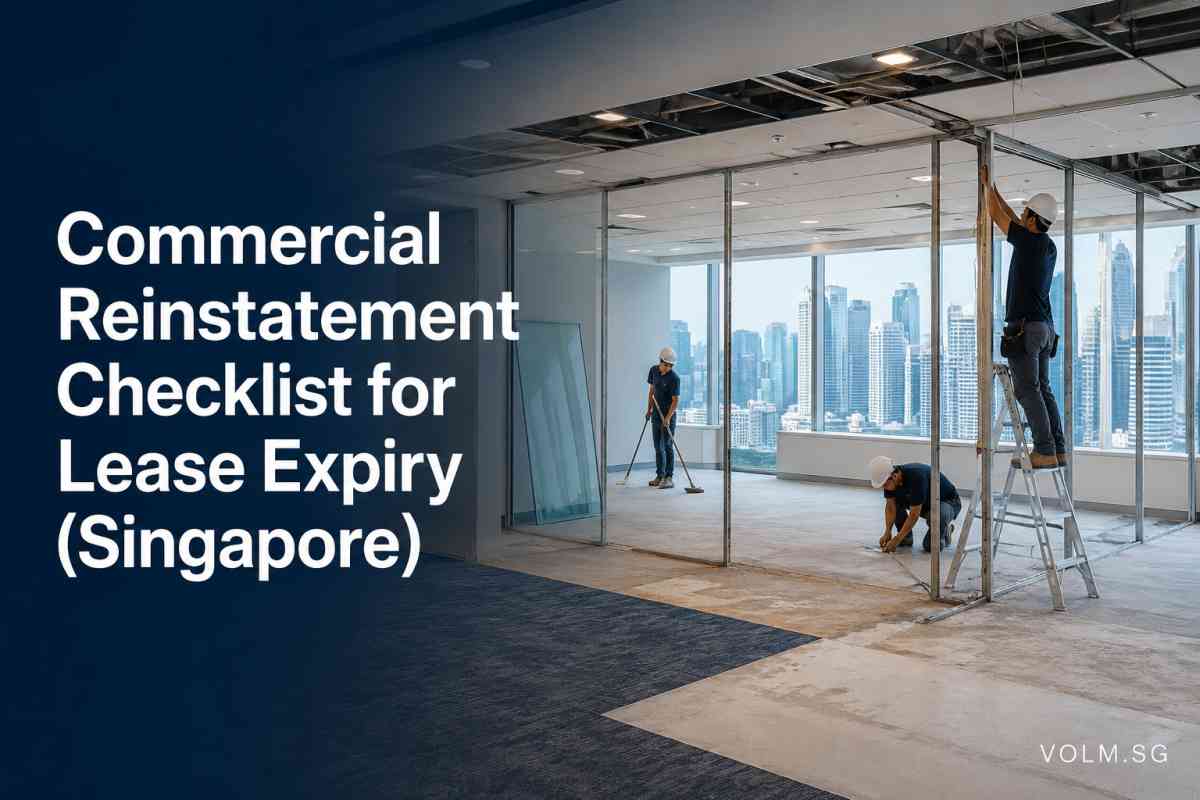
A commercial reinstatement checklist for lease expiry is a structured, step-by-step plan that helps Singapore tenants return their leased space to the landlord's required condition before the lease expiry date.
It covers scope review, building management approvals, physical works, fire safety compliance, and final inspection - so nothing gets missed, and deposits are protected.
A commercial reinstatement checklist translates the reinstatement clause in your lease agreement, landlord letters, and building management regulations into actionable tasks with dates and responsibilities.
It covers the full reinstatement scope: dismantling tenant-installed partitions and fit-out, restoring electrical and mechanical systems, fire safety compliance, surface repairs, final cleaning, waste disposal, and documentation.
For Singapore offices, retail units, and F&B premises, a good checklist helps align commercial tenants, professional contractors, and building management ahead of the joint site inspection and lease handover. A reinstatement checklist should focus on demolition, M&E restoration, and cleaning as its three core workstreams.
Typical checklist items might include:
When a lease expires, the reinstatement process must already be complete - not just starting. Without a checklist, works often run past the lease expiry date, triggering holding-over charges or double rent and unnecessary disputes. Most commercial leases include a reinstatement clause, and failure to comply can lead to deposit deductions.
Structured planning protects your security deposit by reducing incomplete works, last-minute changes, and landlord recharges at premium rates. Ignoring the landlord's reinstatement checklist can result in deposit deductions that exceed what the actual works would have cost.
For business continuity, an organised reinstatement plan frees internal teams to focus on moving to the new office rather than firefighting at the old one. Building management and final inspection windows are limited; a checklist helps fit noisy works, lift bookings, and after-hours access into a realistic programme.
For multi-floor or high-spec commercial spaces - trading floors, medical suites, F&B kitchens - missing technical reinstatement items can cause unexpected delays well beyond the lease expiry date.
Start this step at least 3–6 months before lease expiry, especially for premises above 5,000 sq ft or with heavy M&E modifications. Review the tenancy agreement for specific reinstatement clauses - your reinstatement obligations, scope exclusions, and any side letters that vary the original terms.
Specific reinstatement obligations depend on the lease agreement, so never assume they match a previous tenancy.
Documents to review:
Compare these against the current state of the unit. Reinstatement must restore the unit to its original condition, so confirm what that means for partitions, ceilings, flooring systems, and services. Clarify ambiguous phrases such as "fair wear and tear," "bare condition," or "CAT A" with the landlord in writing.
Obtain written confirmation from the landlord regarding reinstatement expectations. Failing to document the original condition can lead to disputes during the final inspection. Document the original condition with photos before reinstatement begins, and conduct a joint pre-reinstatement inspection with the landlord to agree on what stays and what goes.
Building management in most commercial buildings - whether an MCST, landlord's FM team, or property manager - controls working hours, noisy works, lift bookings, and safety requirements. Early coordination prevents avoidable hold-ups. The property management team will typically require submissions before any reinstatement works can begin.
Typical submissions include:
For necessary permits, examples include MCST work permits, BCA approvals for structural modifications, SCDF submissions for fire safety changes, and LEW endorsement for electrical systems. Not obtaining necessary permits can delay reinstatement work and, in some cases, result in fines.
Allow 1–3 weeks for approval procedures depending on building grade. Grade A CBD offices may have stricter conditions and fewer noisy-work time slots. Professional reinstatement contractors usually prepare the submission pack and liaise directly with building management to keep approvals aligned with building and compliance requirements and avoid administrative delays.
Once lease terms and building rules are clear, convert them into a reinstatement programme and cost plan. Start planning reinstatement works 3 to 6 months before lease expiry for standard projects. At minimum, start planning reinstatement two to three months before lease expiry - starting reinstatement less than two months before lease expiry significantly increases risk.
A typical timeline for office reinstatement:
| Milestone | Timing |
|---|---|
| Scope confirmation | T–12 weeks |
| Appoint contractor | T–10 weeks |
| Submit permits | T–8 weeks |
| Start works | T–6 weeks |
| Internal inspection | T–2 weeks |
| Final inspection | T–1 week |
Reinstatement costs range from S$8 to S$45 per square foot, depending on complexity. Simple office reinstatement typically costs S$8 to S$18 per square foot. Complex reinstatement projects - with heavier M&E, partition removal, and ceiling reinstatement - may cost S$18 to S$35 per square foot.
Grade A office reinstatement costs can exceed S$40 per square foot. Costs increase with additional requirements like fire safety compliance, after-hours work, and specialist waste disposal.
Obtain at least two to three itemised quotations from experienced reinstatement contractors, with demolition, M&E, reinstatement, cleaning, and disposal shown as separate lines.
Build in a contingency of 10–15% in both time and budget for unknowns discovered after demolition - such as hidden services, damaged base-build elements, or raised flooring systems with concealed cabling - so you can cover unexpected costs without derailing the programme.
This is the main technical phase. Below are the physical works most Singapore commercial tenants must address as part of a full reinstatement before the lease ends.
Dismantling and partition removal: Tenants must remove all tenant-installed fixtures during reinstatement. This includes drywall and glass partitions, doors, reception counters, built-in cabinets, meeting pods, pantry fittings, and branded feature walls. Remove temporary partitions installed during tenancy - even those that appear structural.
Ceilings and lighting: Ceiling reinstatement typically involves removing non-original ceiling boards, patching the grid, replacing damaged or discoloured tiles, and returning the lighting layout to the base-build standard. Decommission feature lights, track lighting, or pendant fittings that were not part of the landlord's original installation.
Flooring: Restore flooring to its original condition before handover. This means removing carpet tiles, vinyl, or laminate, grinding off adhesive residue, and reinstating the landlord's specified flooring or bare screed. Flooring restoration should address damaged skirtings and tile chips. Check for data cabling or trunking beneath raised flooring systems that must also be removed.
Signage: Remove logos, wall decals, window films, lightboxes, and external fascia signage. Repair and repaint affected surfaces to match the surrounding finish.
Hidden items: Check for underfloor trunking, cabling in raised floors, and penetrations through slabs. These must be sealed to the landlord's standards or fire safety requirements under SCDF regulations.
Fire safety and electrical systems are frequent reasons for failed final inspection, particularly in higher-spec office towers and F&B units. These items deserve careful attention and regulatory compliance.
Fire safety: Restore fire protection to its original layout: reposition fire sprinklers, smoke detectors, exit signs, and fire alarm devices back to the base-build grid in line with SCDF requirements and Fire Code 2023. Where your fit-out changed the layout of escape routes or detection zones, a qualified person may be required to update drawings and submit to SCDF. Verify this with building management and your contractor.
Electrical systems: Remove all tenant-installed electrical installations during reinstatement. This includes additional distribution boards, power points, and dedicated circuits. Isolate and cap redundant circuits, reinstate original lighting control zones, and obtain a Licensed Electrical Worker (LEW) test or report if the landlord expects one. Improper handling of electrical decommissioning is a common cause of handover rejection.
ACMV: Rebalance or remove extra fan coil units, reinstate diffusers and return grilles, clean filters, and ensure no "dead" duct branches remain open. Coordinate shutdowns and testing with building management to avoid disruption to neighbouring tenants and secure written acceptance.
Once major demolition and commercial reinstatement works are completed, the making-good phase prepares the unit visually and hygienically for final inspection.
Repairs: Patch holes from anchors and cable trays, repair chipped tiles and skirting, close core-drilled openings, and fix damaged door frames or hardware.
Repainting: Repaint walls to the original colour specified in the lease - typically neutral whites or light greys. Use landlord-approved paint brands and finishes where specified.
Cleaning: Professional cleaning is necessary after reinstatement works. Underestimating cleaning requirements can lead to failed inspections. The standard is typically "broom clean": vacuumed floors, wiped ceilings and ledges, cleaned toilets and pantries (if retained), and removal of all loose items and debris.
Waste disposal: Use NEA-licensed waste disposal companies, follow the building's loading bay and lift rules, and keep receipts or disposal reports. Building management may request evidence of compliant disposal before signing off on reinstatement.
A professional reinstatement contractor typically sequences repairs, painting, and final cleaning to minimise rework and prepare the unit for the landlord's walk-through.
Never wait for the landlord's final inspection to discover issues. Conduct internal checks with your own contractor four to eight weeks into the works programme, and again 3–7 days before the formal walk-through.
Create an internal punch list covering all rooms and services, with photos showing completed reinstatement against the landlord's checklist or original handover records. Final walkthroughs should include a snag list to identify unresolved issues before the handover.
Schedule a final inspection before lease expiry, not on the day itself. Conduct a final inspection with the landlord before handover, and ensure the experienced reinstatement contractor is present. A joint site inspection verifies the "bare shell" status of the unit and confirms that reinstatement requirements have been met.
Key documentation to bring:
If minor items are highlighted, arrange quick rectification and request written confirmation once all issues are closed. Clean documentation, clear inspection reports, and a transparent commercial handover are directly linked to timely release of your security deposit and renovation deposits. Conduct a final inspection to ensure compliance with original condition.
Common mistakes include starting reinstatement too late and ignoring hidden costs. Here are the most frequent issues:
Engaging an experienced reinstatement contractor early, and using a structured checklist, significantly reduces the likelihood and impact of these common reinstatement mistakes. Hiring professionals reduces risks of costly reinstatement mistakes and ensures the reinstatement project stays on track.
An experienced reinstatement contractor in Singapore coordinates scope review, site assessment, permits, sequencing of trades, and handover preparation - so the tenant does not have to manage each element independently.
Professional contractors help manage multiple trades under one scope, from demolition through M&E and finishes to final cleaning. Experienced contractors identify scope gaps during the survey stage, before they become expensive problems on site.
VOLM typically starts with a site walk-through and lease review, then prepares a clear scope breakdown for dismantling, M&E, fire safety, finishes, and cleaning - all aligned to what the landlord expects.
A single coordinating contractor manages noisy-work windows, building management communications, waste logistics, and final inspection attendance, reducing internal workload for the tenant.
While no contractor can guarantee deposit return or exact project completion dates, transparent assumptions, progress updates, and photographic records provide better control and fewer surprises. Engaging experienced contractors ensures compliance with landlord requirements and helps future tenants inherit a properly handed-over unit.
If you are approaching lease expiry and need clarity on your reinstatement scope, share the following with VOLM for an initial assessment:
This gives our experienced team enough context to outline the likely scope, timeline, and next steps - with no obligation.
Most office tenants should begin planning 3–6 months before lease expiry. Complex or multi-floor commercial properties may require 6–9 months. Early tasks include reviewing the lease, requesting the landlord's reinstatement checklist, arranging an initial site assessment with experienced contractors, and checking building management lead times for permits and noisy works. Starting early provides room for negotiation on reinstatement scope and reduces the risk of double rent if works overrun past the lease expiry date. Proper planning is the single largest factor in a smooth transition.
In some cases, landlords may reduce or waive certain reinstatement items - particularly if the incoming tenant intends to keep parts of the existing fit-out. Any variation from the original reinstatement clause should be agreed in writing, ideally several months before the lease expiry date. A contractor's scope proposal can support these discussions, so both parties clearly understand the commercial impact. Never rely on verbal agreements for scope reductions - these are difficult to enforce and frequently lead to disputes during lease reinstatement.
Simple removal of non-structural partitions and basic repainting may only require MCST approval, not external authorities. However, works affecting fire safety systems, structural elements, or major electrical distribution typically require additional permits or endorsement from a qualified person, Licensed Electrical Worker, or submission to SCDF. Confirm permit needs during the quoting phase so your programme includes any authority or building management approval time. This is a contractual obligation that cannot be skipped without risk.
It is sometimes possible for small-scope works, but usually impractical for full reinstatement involving hacking, dust, and after-hours work limitations. Consider sequencing: relocate key teams to the new premises first, then ramp up reinstatement at the old leased space once operations are reduced. Building management house rules on noise and safety often determine what is realistically possible during working hours.
Prepare: your current floor plan, original handover documents or photos, the landlord's reinstatement checklist or schedule, your lease expiry date, and any building management guidelines you have received. Include approximate floor area, unit type (office, retail, F&B), and any known technical systems such as specialised AC, server rooms, or kitchen exhaust. Sharing this upfront allows your own contractor to give a more accurate initial view of scope, timeline, and next steps for your reinstatement in Singapore.