
close
close
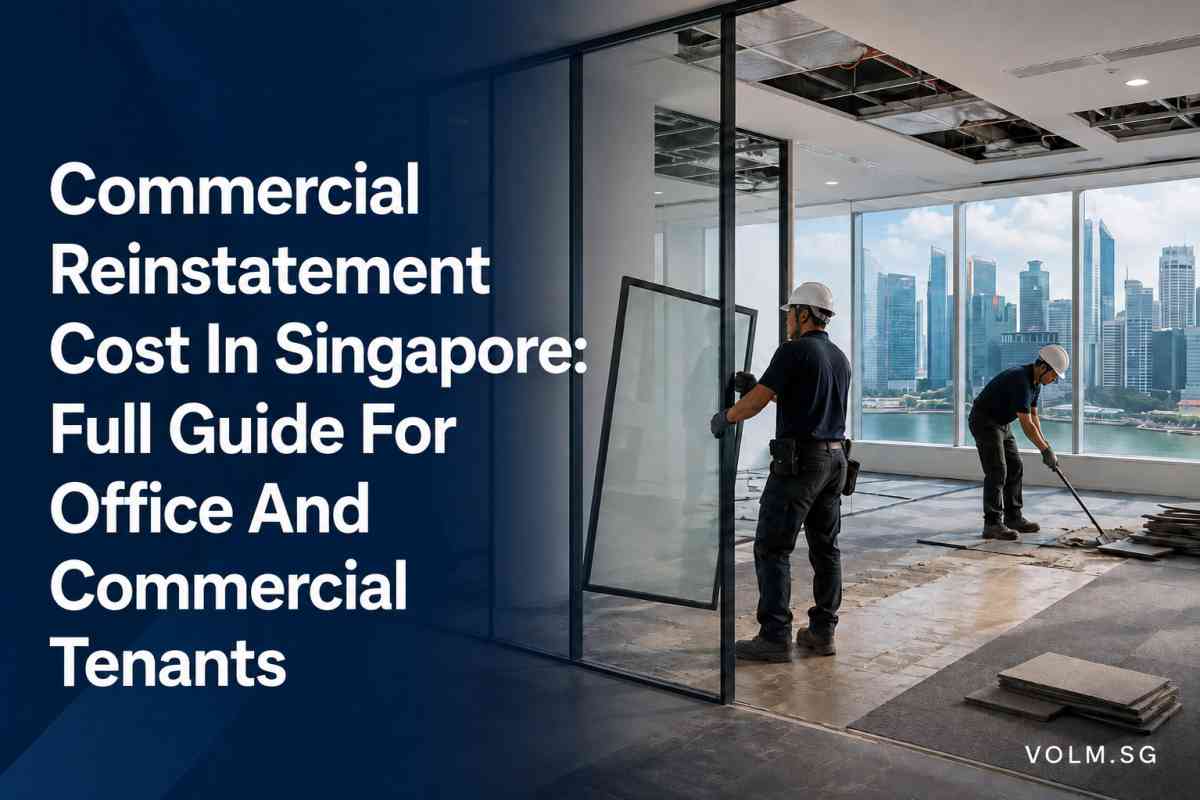
Commercial reinstatement cost in Singapore typically ranges from S$8 to S$30 per square foot, depending on whether the premises are used as an office, retail unit, or F&B outlet. It represents the budget needed to return a commercial property to the landlord's required handover condition at lease expiry, as defined by the lease agreement and building management rules.
This guide focuses on reinstatement for Singapore commercial property - especially office reinstatement - and helps tenants understand what influences reinstatement costs, how to budget realistically, and how VOLM supports clearer planning from site visit to handover.
Commercial reinstatement cost is the estimated amount needed to restore an office, retail, industrial, or F&B unit to the contractually required handover condition; when the unit is an office, this is also commonly discussed as the office reinstatement cost.
This covers all reinstatement work - dismantling partitions, removing built-in furniture, restoring false ceilings, painting walls to original colour, and making good mechanical and electrical systems. It excludes rent, insurance premiums, and incoming fit-out costs.
Reinstatement costs in Singapore range from S$8 to S$30 per square foot, though actual figures vary depending on scope:
On average, reinstatement in Singapore costs between S$1,000 and S$30,000 for a typical commercial unit, depending on unit size and fit-out complexity.
Reinstatement cost is separate from renovation cost and from insurance reinstatement valuations. A Reinstatement Cost Assessment used for insurance purposes - often prepared by chartered surveyors - differs because reinstatement cost assessments vary from market value as they exclude land value. This article deals specifically with tenant reinstatement works at lease end, not insurance valuation.
The starting point for any reinstatement project is always the lease contract and any attached plans, plus the building management handbook. VOLM does not guarantee deposit returns or approval processes, but helps clarify scope, risk items, and realistic cost bands before a tenant commits.
Reinstatement is a mandatory obligation in lease agreements. Tenants must restore the property to its original condition - or the condition specified in their lease - before handover. Failure to comply with reinstatement obligations can lead to penalties, including holdover rent and forfeiture of the security deposit.
For many tenants, reinstatement costs directly affect cash flow at lease expiry. Underestimating it can force rushed decisions, variation orders, or landlord-charged reinstatement at premium rates. This is especially common in CBD Grade A commercial buildings with strict management requirements.
From the landlord and commercial property owner perspective, reinstatement protects building fabric, common areas, and incoming tenants. Property owners enforce specific building requirements, permits, and inspection processes to maintain consistent baseline conditions.
Many tenants only discover the full reinstatement scope during the last three months of their lease, when it is already difficult to negotiate or reduce costs. Accurate estimation of reinstatement costs helps avoid unexpected expenses and financial risks - including underinsurance risks where deposit shortfalls leave tenants exposed. Early planning also protects business continuity and staff morale by preventing last-minute noisy works during business hours.
Several factors influence reinstatement costs. The main drivers are:
Technical influences also matter: the number of data points and electrical wiring runs to remove, whether air conditioning systems must be fully removed or simply made good, the quantity of floor tiles and ceiling boards to reinstate, and the extent of hacking required.
Common hidden costs that affect budgets include fire-stopping, replacement of damaged base-building items, reinstatement of landlord-standard doors and hardware, and additional cleaning required by certain buildings.
The reinstatement obligation in Singapore is primarily defined by the lease agreement, typically through a reinstatement clause and an attached layout or schedule of condition recorded at lease commencement. Lease agreements can dictate specific reinstatement responsibilities at lease expiry, and the wording matters considerably.
Different phrasing leads to very different scope. A clause requiring "restore to bare shell condition" means stripping everything back to concrete and services. A clause stating "original condition subject to fair wear and tear" may allow retention of certain finishes. The correct amount of work involved depends entirely on how the lease is drafted.
Tenants should cross-check lease clauses with building rules - the fit-out guidelines or house rules published by building management. These may specify door hardware standards, common-area protection, fire-protection requirements, and working-hour restrictions.
For example, a CBD office tower in Raffles Place may require full-height hoarding, lobby floor protection, and higher insurance coverage. An older industrial building in Tai Seng may allow more flexible working hours and simpler protection measures.
A practical tip: review reinstatement clauses before signing a lease for a new office, and request written clarification on any ambiguous phrases from the landlord or agent. This small step can significantly reduce costs and disputes later.
A clear reinstatement quotation should itemise scope into logical cost components rather than providing one lump sum. This allows decision-makers to compare by typical scope, not only by total cost.
| Cost component | Description | When it becomes significant |
|---|---|---|
| Demolition and dismantling | Removing partitions, built-in joinery, raised flooring, cabinetry | Dense room layouts, large built-in pantries |
| M&E removal and making good | Disconnecting electrical wiring, data cabling, lighting | Server rooms, high data-point density |
| Ceiling works | Reinstating false ceilings, grid systems, acoustic tiles | Units with feature or custom ceilings |
| Flooring | Removing carpet, vinyl, or floor tiles; restoring base finish | Units with multiple flooring types |
| Wall repair and painting | Patching holes, painting walls to original colour | Heavily partitioned spaces |
| Fire-stopping and safety | Sealing penetrations, reinstating fire-rated doors | Any unit with modified fire compartments |
| Waste disposal and haulage | Disposal of debris and waste materials via licensed contractors | F&B, dense fit-outs |
| Permits and approval processes | Building management permit fees, security deposits | CBD and premium commercial buildings |
| Common-area protection | Hoarding, floor protection to lobbies and corridors | High-traffic buildings, malls |
| Final cleaning | Deep cleaning to landlord standard | Most commercial units |
Office reinstatement in Singapore usually covers standard local handover works such as dismantling partitions (gypsum or glass), removing workstation joinery, stripping carpet or vinyl flooring, reinstating ceilings and lighting, and removing data cabling, making it typically the least expensive among commercial property types.
Average office reinstatement costs range from S$10 to S$30 per square foot, depending on fit-out density and office size. Key cost drivers are the number of enclosed rooms and amount of built-in joinery.
Retail reinstatement adds complexity. Singapore tenants in malls must reinstate shopfronts, remove external signage, strip display carpentry and feature ceilings, and comply with mall management rules around hoarding, noise control, and restricted working hours. Disposal fees for shopfront materials and specialist lighting add to the budget.
F&B reinstatement carries the heaviest scope. Kitchen demolition, exhaust ducting removal, capping water and gas points, making good wall and floor tiles, and reinstating landlord-standard ceilings and fireproofing are all typical.
Reinstatement costs can reach S$15 to S$30 per square foot for F&B units - sometimes higher where SCDF fire safety requirements demand additional compliance work.
In mixed-use buildings, adjacent sensitive uses (clinics, hotels, schools) can limit noisy works to specific time windows, adding additional costs regardless of premises type.
Hidden costs may include disposal fees and minor repair works that are easy to overlook during initial budgeting. Typical examples:
Include a 10–15% contingency budget for unforeseen reinstatement costs. Inflation factors should also be included in reinstatement cost calculations to account for construction cost increases over time. Regular reviews of reinstatement cost estimates are recommended to reduce underinsurance risks, particularly for longer leases.
Common mistakes that inflate budgets:
Unclear documentation at lease start compounds these problems. Without photos or drawings of the original condition, disputes arise over whether carpets, lights, or doors are the landlord's or tenant's responsibility, leading to hidden fees and cost overruns.
Proper planning reduces risk. Here is a step-by-step checklist:
6 months before lease expiry: Review your lease agreement, reinstatement clauses, and any schedules of condition. Clarify ambiguous wording with your landlord or agent and confirm agreements in writing. Allow sufficient time for this - rushed interpretation leads to scope disputes later.
4–5 months before: Conduct a site visit with an experienced contractor to map existing fit-out elements against likely reinstatement requirements. Photograph key areas and discuss any special management requirements with building management.
3–4 months before: Request multiple quotations with detailed scope breakdowns. Obtain multiple quotations from at least three contractors to compare reinstatement costs effectively. Ensure the contractor provides a clear scope of work in quotes. Check for hidden costs in each contractor's quotation - particularly exclusions around waste disposal, fire-stopping, or common-area protection. Evaluate contractor experience with commercial reinstatement projects and verify that contractors are BCA-licensed for full compliance with regulatory requirements.
2–3 months before: Appoint a transparent contractor, submit permit applications to building management, plan noisy versus quiet works, and align the reinstatement schedule with your relocation to a new office to minimise downtime and avoid unexpected expenses.
Final month: Confirm handover inspection dates with the landlord. Complete punch-list rectifications. Return all keys, access cards, and manuals. Document the final condition with photographs for your records.
VOLM is a Singapore office and commercial reinstatement contractor providing reinstatement services for office and commercial handovers, focused on clear scope planning, practical advice, and managed handover preparation. The typical engagement flow is straightforward:
VOLM helps identify cost-effective approaches and coordinates with the client's new office renovation timeline where relevant. We encourage clients to obtain multiple quotations for market comparison - a practice that strengthens confidence in service quality and pricing.
Where variations arise during reinstatement - such as discovery of concealed services or landlord-requested changes - VOLM communicates clearly before additional work proceeds. This reduces financial risks and keeps the reinstatement process on track.
If your business is considering office reinstatement in Singapore within the next 3–12 months, preparing the right information upfront helps any contractor - including VOLM - respond with a more accurate scope and cost indication.
Key details to gather:
Where possible, also share existing floor plans, photos of key areas (pantry, server room, reception, partitions), and any landlord communication on handover standards. These data points allow for a more realistic preliminary view of scope and cost drivers.
Early engagement typically reduces the risk of rushed decisions, variation orders, and business disruption. It also helps align your reinstatement project with the move into a new office or commercial space - avoiding double-rent periods and unnecessary downtime.
Contact VOLM for a no-obligation discussion focused on scope clarification and practical next steps, rather than just price. Share your details, and we will help you understand the work involved, the key components that drive cost, and a sensible project timeline for your handover.
Reinstatement cost in Singapore typically ranges from S$8 to S$30 per square foot. Average office reinstatement costs range from S$5 to S$15 per square foot for basic layouts, and up to S$30 per square foot for complex fit-outs. F&B units sit at the higher end. Building rules, fit-out condition, and project timeline can all move a project towards the upper or lower end of these bands.
Start 3–6 months before lease expiry. This allows sufficient time for permit lead times, quotation comparison, and coordination with your new office fit-out. Many tenants who begin later face compressed schedules, premium labour rates, and limited contractor availability - all of which increase cost.
Reinstatement clauses can sometimes be adjusted during lease negotiation - for example, agreeing on partial reinstatement or retention of certain partitions. Any changes must be captured clearly in the lease or a side letter. Once signed, the reinstatement scope is generally contractually binding.
A Reinstatement Cost Assessment (RCA) determines expenses required to rebuild a property after total loss and is typically prepared by chartered surveyors - relevant where a commercial property is insured and needs valuation. For physical reinstatement works at lease end, professional contractors handle the scope. Both services serve different purposes; the Royal Institution of Chartered Surveyors framework applies to the former.
To avoid unexpected expenses: insist on detailed scopes, conduct thorough on-site inspections, check building requirements with management, and query any "excluded" items in quotations. Practical tips include photographing original conditions at lease start and budgeting a 10–15% contingency.
Typical requirements include layout drawings, method statements, a work schedule, public-liability insurance certificates, contractor licences, and security deposits to management. Requirements vary depending on the commercial building, so confirm early with your building management team.