
close
close
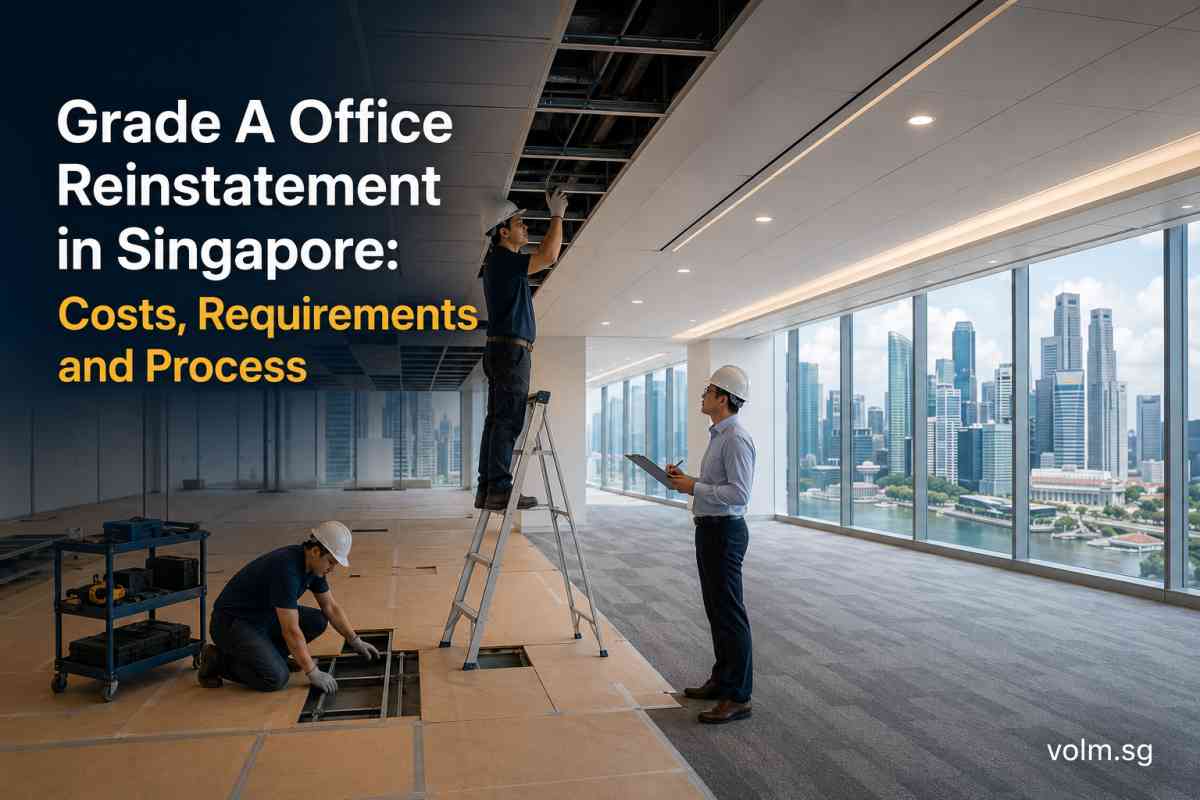
Grade A office reinstatement in Singapore is the process of restoring a high-spec leased office—typically in a premium CBD tower or business park campus—to the condition required by the landlord’s reinstatement schedule and lease agreement.
It involves removing tenant fit-out works, restoring mechanical and electrical systems, and preparing the space for handover in line with building and landlord requirements.
For tenants in Grade A offices, property managers, and fit-out or reinstatement teams, the key issues are usually scope, cost, compliance, timeline, waste disposal, safety, and the technical challenges that can affect handover.
Because reinstatement in premium office buildings is a contractual obligation with little room for error, getting it right helps prevent landlord disputes, deposit deductions, delays, and regulatory problems at lease expiry.
This article explains what drives scope and cost, how the reinstatement process works in practice, what compliance standards and building guidelines apply, and how to approach contractor selection and project planning.
Grade A office spaces in Singapore often have premium infrastructure and strict guidelines enforced by landlords.
Office reinstatement in these buildings goes beyond simple strip-out: it means returning the space to the landlord's base or CAT A condition, including ceiling systems, lighting, ACMV layout, flooring systems and fire protection.
Reinstatement is a mandatory contractual obligation for commercial spaces in Singapore, and office reinstatement restores leased space to original condition as defined in the tenancy agreement.
Cost and complexity in Grade A buildings are driven by landlord reinstatement schedules, integrated M&E systems and building management requirements-not just floor area.
The extent of partition removal, electrical modifications, raised flooring restoration and specialist approvals all shape the final bill far more than square footage alone.
Tenants should review the reinstatement clause in the lease several months before expiry to avoid disputes.
Securing the landlord's reinstatement checklist, original handover documents and building guidelines early-ideally six to nine months ahead-helps prevent variation orders and reduces the risk of deposit deductions.
VOLM works as a calm, experienced project partner that can interpret reinstatement requirements, coordinate with the building management team, manage demolition and M&E restoration, restore finishes to the required standard and prepare for the final inspection so that landlord disputes and deposit losses are minimised.
Grade A office reinstatement refers to the process of restoring a high-spec office in a premium building-such as those at Raffles Place, Marina Bay, Orchard, One-North or Changi Business Park-to the original configuration required by the landlord's reinstatement schedule and lease agreement.
This usually means returning the space to CAT A or the landlord's base-build condition, covering ceilings, lighting, air-conditioning layout, flooring and fire protection, rather than leaving an empty bare shell.
In practical terms, reinstatement involves restoring the office to its original condition by reversing all tenant fit-out works.
Tenants must remove all tenant-installed fixtures during reinstatement, including partition walls, joinery, cabling, raised flooring changes and any specialist installations such as server rooms or wet pantries. The building structure, shared services (lifts, risers, fire-escape routes) and core systems remain untouched.
Compared with general office reinstatement projects in Singapore, Grade A office reinstatement is usually more demanding due to stricter approvals, higher finishing standards, and tighter regulations.
Grade A buildings require reinstatement to original specifications, with stricter approvals from building management, more integrated building systems to coordinate around, tighter noise and access controls, and higher landlord expectations for cleanliness and finishes at handover. The difference is not just cosmetic-it affects scope, cost and programme from day one.
Landlords and asset managers for Grade A towers-particularly newer CBD and fringe CBD buildings completed after approximately 2010-enforce higher reinstatement standards to protect rental yields, brand reputation and operational reliability for future tenants.
A poorly reinstated floor can delay re-leasing and affect the perception of the entire building.
Premium buildings have more complex mechanical, electrical and plumbing systems, often linked to a central Building Management System (BMS) controlling HVAC, lighting and fire suppression.
Careless demolition or disconnection can create system imbalances, trigger alarms or compromise fire safety. Reinstatement in Grade A buildings often needs additional approvals to ensure these systems are returned to a safe, compliant state.
Grade A buildings typically restrict noisy work to after office hours or weekends to minimise disruption to neighbouring tenants. High-traffic lobbies, shared lift lobbies and adjoining office spaces require strict controls on dust, material movement and access.
Building management requires multiple inspections before accepting reinstatement work in Grade A buildings, and landlord facilities teams, external consultants or specialist engineers may each review documentation at different stages, raising the bar on what experienced contractors must deliver.
Start with three documents: the signed lease agreement, the original handover schedule (CAT A or CAT B description) and the latest landlord reinstatement schedule or checklist. Gather these ideally six to nine months before lease expiry.
Most commercial leases require reinstatement before lease handover, and tenants are responsible for reinstatement costs as per lease agreements.
Reinstatement clauses define what must be removed and what must remain. Typical removals include tenant-installed partitions, wet pantries, additional electrical or data points, server rooms and custom joinery.
Items that typically stay include base carpeting, suspended ceilings and grid, original raised flooring, base lighting fixtures and fire-sprinkler risers. Landlords often require a refundable renovation deposit, released after satisfactory reinstatement checks.
Separately, building management often issues technical and safety guidelines covering demolition methods, waste disposal routes, working hours, protection to common corridors and mandatory method statements or risk assessments. These management requirements sit alongside-but are distinct from-the lease agreement.
A common clause reads: "The Tenant shall at its own expense reinstate the Premises to its original condition or to such condition as may be required by the Landlord." Phrases like "original condition" can be vague if the handover state was never formally documented.
Tenants should clarify in writing what is included or excluded before any reinstatement work begins. This is where early engagement with an office reinstatement contractor helps translate legal language into a workable project scope.
Office reinstatement cost in Grade A buildings is driven mainly by fit-out complexity, M&E modifications, raised flooring systems, landlord technical requirements, waste volume and project timeline pressure-not just square footage.
A lightly modified open-plan floor will cost significantly less than a space with glass partitions, a server room, multiple meeting pods and a fully plumbed pantry.
Reinstatement costs range from SGD 8 to SGD 30 per square foot for many commercial and industrial reinstatement projects. For Grade A spaces, reinstatement costs generally range from S$10 to S$40+ per square foot, depending on scope.
These figures are broad estimates, and any reliable quotation should be based on an itemised scope aligned with the landlord's schedule rather than a blanket per-square-foot rate.
Typical cost drivers include:
Extent of partition removal-dismantling costs for drywall differ from dismantling partitions made of frameless glass
Number of electrical and data points to remove or re-cap
Ceiling reconfiguration and patching
Flooring repair or replacement
Server room decommissioning and mechanical installations removal
After-hours or weekend work premiums
Specialist endorsements and compliance costs for fire safety or structural submissions
In Grade A towers, building-management levies, goods-lift bookings, security escorts and NEA-licensed waste disposal can form a significant line item.
Hidden costs can significantly increase the final reinstatement bill if these charges are not clearly identified in quotations. Always ask contractors to separate these additional costs and hidden fees from base trade pricing so you can compare proposals fairly.
This section covers the main technical work packages that typically appear in office reinstatement projects in Grade A buildings and how they affect risk, cost and programme.
Partition removal and dismantling partitions. Common steps in office reinstatement include demolition and removal of partitions and built-in furniture.
Glass partitions-especially full-height, frameless or double-glazed systems-require careful sequencing to avoid damaging adjacent flooring and ceiling systems.
Drywall and metal-stud partition walls similarly need controlled demolition, with embedded cabling and electrical points removed and surfaces patched.
Raised flooring and specialist flooring systems. Restoration of raised flooring systems is mandatory in Grade A offices.
This means removing tenant-installed floor box cut-outs, non-standard platforms or over-raised sections, making good pedestals and sub-floors, and reinstating original carpet tiles or vinyl finishes.
If original finishes have been discontinued, an acceptable alternative must be agreed with the landlord.
Integrated ceilings, lighting and fire systems. Suspended ceilings, feature installations and ceiling board layouts with integrated lighting may have been altered during fit-out.
Reinstatement must return sprinkler heads and smoke detectors to compliant spacing, close unused penetrations, patch ceiling grids and align everything with the building's ACMV layout.
Fire safety modifications require compliance with SCDF guidelines during reinstatement, and plans for such works must be submitted by a Qualified Person.
Data cabling, server rooms and data infrastructure. Tenant installations such as server racks, containment systems and telecom rooms must be decommissioned.
Cabling is removed or capped, slab penetrations sealed to fire-rated standards, and base-building riser integrity maintained.
Electrical systems must be restored to original configurations during reinstatement, including lighting control circuits, power distribution and outlet layouts. Coordination with the tenant's IT vendors is often needed to ensure a clean handover.
VOLM follows a structured reinstatement process for Grade A office reinstatement to control reinstatement costs, manage risk and meet fixed handover dates.
Office reinstatement typically requires careful planning and compliance with building management regulations, and a clear sequence helps the work be completed efficiently while keeping each stage on track.
The typical office reinstatement process runs as follows:
Pre-lease-expiry consultation and document review
Site survey and condition mapping against the original handover baseline
Scope alignment with the landlord and building management team
Detailed cost plan, programme and trade procurement
Permit applications-permits are necessary for reinstatement work in Grade A buildings, especially for hacking and electrical work
Demolition and strip-out, including Singapore demolition of partitions, joinery and tenant installations
M&E and architectural reinstatement-ceiling, flooring, lighting, ACMV and plumbing systems
Internal quality checks, snagging and touch-ups
Final cleaning and preparation for the handover inspection
Landlord and building management final inspection support
In many CBD Grade A towers, noisy hacking and demolition are limited to evenings or weekends, so VOLM sequences work to fit these windows and avoid project delays.
Reinstatement may require submission of technical drawings and method statements for approval before mobilisation can begin.
Reinstatement projects in Grade A buildings take 6–8 weeks on average. Office reinstatement typically takes four to eight weeks to complete, though reinstatement processes can take 2 to 8 weeks depending on the size and complexity of modifications.
Documentation-method statements, risk assessments, hot-work permits, photographs and as-built sketches-is typically requested by building management and should be prepared systematically throughout the reinstatement project.
Construction and reinstatement waste from Grade A offices includes gypsum boards, glass partitions, carpets, raised flooring panels, cabling and joinery. All of this must be removed via approved routes and disposed of by NEA-licensed contractors.
Waste disposal during reinstatement must follow NEA guidelines in Singapore, and building management may specify protected hoardings, floor and lift protection, dust-control measures and designated holding areas for skips in basements-all of which influence reinstatement planning.
Compliance with Workplace Safety and Health standards is mandatory for contractors during reinstatement. Improper handling of waste or unsafe demolition practices can lead to fines, work stoppages, additional disposal trips and potential insurance complications.
BCA building regulations and MOM/WSH requirements apply to any works that involve structural integrity, ventilation modifications or hazardous materials.
VOLM's role includes planning safe work sequences, conducting toolbox briefings, providing on-site supervision and maintaining clear photographic records.
This approach helps clients demonstrate due diligence and supports regulatory compliance if any incident or query arises during the reinstatement work.
The main challenges in Grade A office reinstatement include meeting timelines and coordinating with building management.
For this reason, proper planning for a complete reinstatement should typically begin four to nine months before lease expiry, depending on the size of the office and the extent of the fit-out.
Key internal milestones to consider:
6–9 months out: Inform regional leadership, review the lease agreement and gather reinstatement documents
4–6 months out: Appoint a professional reinstatement contractor and freeze floor plans
3–4 months out: Lock in move-out dates, submit permit applications and confirm the project timeline
2–3 months out: Mobilise works, with buffer time for approvals and restricted work hours
Early contractor engagement helps validate landlord expectations, surface potential risks-such as raised flooring cut-outs, structural openings or wet areas-and shape a realistic programme that factors in permit lead times and building management requirements.
This reduces the chance of paying double rent or extension penalties when the lease ends.
Final inspection and correcting deficiencies are required before handing back the office to landlords. Handover inspections are crucial to ensure compliance with original condition requirements before lease expiry.
Tenants should aim for an interim inspection with the landlord if possible, well before the final handover date, to identify any outstanding items early and ensure timely completion.
Pre-handover checklist:
Document the original condition with photographs at move-in
Gather all as-built drawings from the fit-out period
Confirm scope in writing with the landlord
Schedule an interim inspection if the landlord permits
Budget a 10–20% contingency for unforeseen works
VOLM is a Singapore-based office and commercial reinstatement and fit-out contractor focused on clear scoping, coordinated execution and professional handover preparation for Grade A and high-spec buildings.
The experienced team works across CBD towers and business park campuses, handling reinstatement work that Singapore tenants need to meet their lease handover obligations.
VOLM typically engages through an initial conversation, a free site walk-through for qualifying projects, a review of the lease and reinstatement schedules, and a structured proposal that itemises major trades: demolition, partition removal, ceiling and flooring restoration, M&E reinstatement, painting, final cleaning, waste disposal and contingency allowances.
The goal is a reliable quotation that reflects the actual project scope rather than a vague lump sum.
VOLM does not promise to be the cheapest option. Instead, the focus is on reducing uncertainty through transparent inclusions and exclusions, clear assumptions on working hours and building-management fees, and practical sequencing aligned to the client's move-out plan.
Service quality and project completion are measured by whether the office handover proceeds without avoidable disputes or deposit deductions.
When selecting any professional contractors for your reinstatement work, engage contractors familiar with Singapore's building codes. Request at least two to three quotations before choosing a contractor.
Check contractor references and past project experience, and look for contractors with experience in Grade A office reinstatement. Ensure the contractor provides a detailed reinstatement plan covering scope, programme and assumptions.
Ready to get started? Share your premises type and approximate size, building name and location, target handover or lease expiry date, and any landlord reinstatement checklist or floor plans you have available. This helps VOLM provide a more accurate view of next steps and a scope-specific proposal.