
close
close
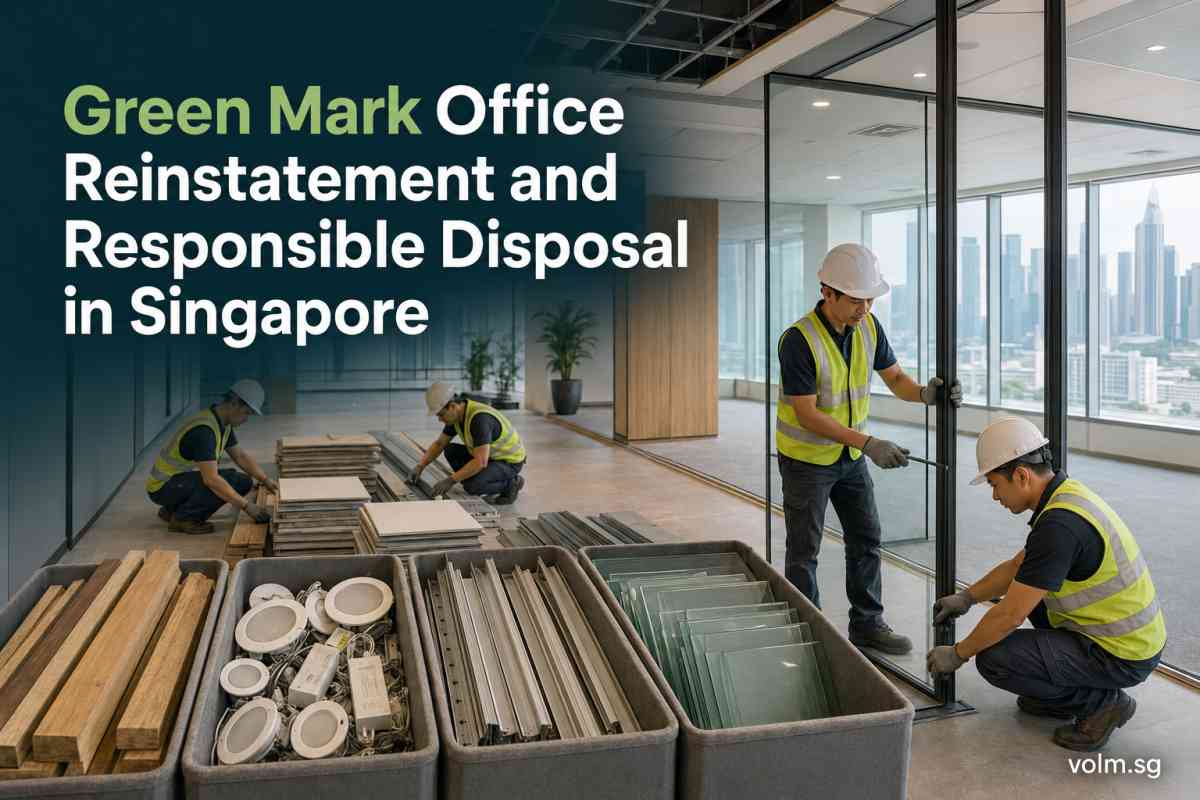
Green Mark office reinstatement and responsible disposal refers to returning a leased office space to its original condition at lease end while aligning dismantling, reuse, segregation, recycling, and waste-handling decisions with BCA Green Mark sustainability principles.
For tenants, facilities managers, office occupants, and property managers handling lease-end works in Singapore, it replaces the conventional "gut and dump" method with waste reduction, material recovery, and certified green products that better fit Green Mark-certified buildings.
This guide explains how Green Mark-aligned reinstatement relates to BCA requirements, how to plan timelines and scope of works, when to run waste audits, which disposal pathways and sustainable alternatives to use, what the cost implications are, and which common mistakes lead to disputes or avoidable waste.
In a market where many commercial buildings are Green Mark certified, following these practices supports ESG goals, strengthens landlord relationships, reduces reinstatement risk, and can lower disposal and replacement costs.
Office reinstatement restores spaces to their original condition before lease handover, but sustainable reinstatement emphasises environmental responsibility over speed and cost alone. Here are the essential points:
Green Mark alignment during reinstatement means reducing waste, reusing fittings where feasible, and choosing certified green products for any make-good works - supporting both the building's BCA Green Mark goals and your own ESG reporting.
Responsible disposal covers waste audits, on-site segregation, recycling, engagement of NEA-licensed hauliers, and documentation that can support BCA Green Mark certification and corporate sustainability dashboards.
Early planning - typically 6–9 months before lease expiry - reduces reinstatement costs, limits variation orders, and minimises business disruption.
Over 4,500 buildings in Singapore achieved Green Mark certification by 2025, meaning many tenants will encounter sustainability expectations during reinstatement.
Green Mark-aligned office reinstatement means returning premises to the landlord's required condition while making deliberate choices about dismantling, material reuse, and waste disposal that support the building and construction authority's sustainability framework.
It differs from standard reinstatement - which typically prioritises speed and lowest cost, often sending most removed materials to incineration - by incorporating waste segregation, reuse pathways, and certified sustainable materials into the reinstatement process.
This matters commercially because many commercial buildings in Singapore's CBD, Marina Bay, and Raffles Place already hold BCA Green Mark certification at Certified, Gold, GoldPlus, or Green Mark Platinum levels.
Landlords in these Green Mark-certified buildings increasingly expect tenants to follow building-level sustainability protocols during fit-out and reinstatement.
Green Mark certification was launched in 2005 by BCA, and Green Mark-certified buildings save 30–40% energy compared to conventional buildings. Across Singapore, Green Mark buildings save S$1.3 billion annually in costs.
For tenants, aligning reinstatement with these standards supports ESG reporting, strengthens relationships with landlords, and reduces the risk of disputes at handover. Proper planning helps avoid delays and penalties during reinstatement - and protects your security deposit.
The BCA Green Mark scheme is Singapore's national green building rating system, led by the construction authority. Green Mark certification evaluates buildings on five key criteria: energy efficiency, water efficiency, environmental protection, indoor environmental quality, and innovation.
For existing buildings and office interiors, Green Mark includes credit areas for sustainable procurement, construction waste management, and responsible disposal during fit-out and reinstatement.
Under criterion CN 2.3, buildings undergoing major retrofitting must demonstrate conservation of structure and recovery of demolished materials - for example, directing at least 40% of crushed concrete waste to approved recyclers.
Under CN 2.2, at least 60% by cost of replacement finishes should be certified sustainable products. Buildings can earn up to 2 points specifically for waste management activities.
Green Mark certification requires recertification every three years, which means building owners have ongoing incentives to maintain sustainability performance - including how tenant reinstatement waste is handled. Many Green Mark Platinum and GoldPlus office towers require tenants to follow building waste and reinstatement protocols aligned with Green Mark criteria.
The new BCA Green Mark for Interiors scheme will standardise sustainable practices for office fit-outs from November 2025, further raising expectations for tenants in certified buildings.
While individual tenant reinstatement may contribute only a small portion of total Green Mark points, it demonstrates alignment with landlord sustainability objectives and corporate ESG frameworks - a competitive advantage when negotiating future leases.
Responsible reinstatement is planned around reduction, reuse, and high-value recycling rather than simple demolition and mixed disposal. Responsible disposal practices aim to reduce landfill waste and conserve resources.
The core principles follow a clear waste hierarchy:
Avoid generating waste where possible (negotiate to leave acceptable fittings in place)
Reduce volumes by careful dismantling rather than destructive demolition
Reuse items such as workstations, glass partitions, and lighting
Recycle - materials such as glass, metal, wood, and plastics should be separated for recycling during office reinstatement
Recover energy where recycling is not feasible
Dispose responsibly as a last resort, using NEA-licensed waste collectors
Office reinstatement projects must follow strict disposal standards for hazardous and electronic waste. Keeping documentation such as waste transfer notes can support green certifications and audits.
Coordinating with building management early is essential to understand existing recycling streams, dock access rules, and lift booking windows that affect how materials leave the building.
Safety and compliance remain non-negotiable: adherence to Workplace Safety and Health requirements, fire-code constraints when stockpiling dismantled materials, and NEA regulations on waste transport.
When selecting an office reinstatement service provider, ask about their disposal partners, track records, and ability to report tonnages by material stream - these data points become valuable for Green Mark and ESG dashboards.
For any office space above 5,000 sqft, start planning 6–9 months before lease expiry or your targeted handover date. Even smaller commercial spaces benefit from beginning at least four months ahead.
Reinstatement projects often involve strict timelines and building regulations that compress quickly if planning is delayed.
A staged approach works well:
Lease and Green Mark review - re-read your tenancy agreement's reinstatement requirements alongside the building's sustainability policies
Site walk and photographic documentation - capture the current state of the office interior and compare against as-built drawings or original handover photos
Asset identification - flag high-value reusable items: workstations, glass partitions, LED lighting, and ceiling grids
Landlord and building management discussion - confirm what stays, what goes, and what disposal protocols apply
Include sustainability criteria in your reinstatement brief and contractor quotations: minimum recycling rates, reporting format, and preference for low VOC paints or other certified sustainable materials in any repair or repainting works.
Green certifications require verifiable data proving waste was diverted from landfills - so build this expectation into the scope from day one.
A realistic schedule aligned with building quiet hours and lift booking restrictions avoids premium after-hours charges. Clear early scope definition reduces change orders, supports more accurate pricing, and allows time to arrange reuse pathways before demolition begins.
Reinstatement works include dismantling partitions and removing built-in fittings, reinstating original ceilings and lighting, removing data cabling, repairing flooring, repainting walls, and final cleaning. Final touch-ups and cleaning are completed before landlord inspection.
For each category, sustainable choices are available:
| Work Category | Standard Approach | Green Mark-Aligned Alternative |
|---|---|---|
| Partitions | Demolish and dispose as mixed waste | Carefully remove modular partition systems for reuse or donate; modular partition systems are popular in sustainable office design |
| Ceiling tiles and grids | Strip and bin | Salvage intact grids; recycle aluminium components |
| Lighting | Remove and discard | Separate LED lighting for e-waste recycling |
| Flooring | Rip up and dispose | Use recycled-content carpets for replacements; recycled-content carpets reduce environmental impact in offices |
| Painting | Any available paint | Specify low voc paints; low-VOC paints improve indoor air quality significantly |
| Timber repairs | Standard timber | Sustainably sourced timber must be certified by recognised standards such as FSC |
| Acoustic panels | Dispose | Acoustic panels made from recycled fibres offer environmental benefits and may be donated |
Energy efficiency considerations still apply at the end of the lease. Switch to temporary task lighting during works, avoid unnecessary air conditioning operation, and schedule noisy work in compact windows to reduce extended after-hours energy consumption.
Where make-good works require new materials, tenants may choose products that support the base building's green mark positioning and improve indoor air quality.
Not every item can be recycled in practice, so realistic targets and clear segregation instructions to workers are essential to avoid contamination of recyclables.
A pre-works material inventory is a structured assessment of what will be removed - furniture, partitions, carpets, IT equipment, signage - and its approximate quantities by category. Waste audits help identify waste management improvements and can uncover inefficiencies in waste handling.
For small to mid-sized offices, a simple in-house inventory often replaces a full formal audit. A project team member can catalogue items using annotated floor plans and spreadsheets organised by zone.
For larger or multi-floor tenancies, a professional audit provides more accurate reporting. Waste audits can cost between $5,000 and $25,000 in Singapore, depending on several factors including office size and complexity. Annual waste audits enhance understanding of waste profiles across a portfolio.
The data useful for Green Mark and ESG reporting typically includes:
Estimated tonnes diverted from landfill or incineration
Proportion reused, donated, or recycled
Breakdown by material stream: metals, glass, gypsum, soft furnishings, e-waste
Required documentation such as disposal receipts and recycler certificates
Practical tools include annotated floor plans, simple spreadsheets, and photographic logs before and after removal - designed so non-technical stakeholders can follow the data.
VOLM can work with the client's sustainability team or appointed consultant to align site practices with data requirements, without overcomplicating the reinstatement process.
Materials removed during reinstatement typically follow one of these pathways:
Internal reuse - redeploying furniture or fittings to a new office or another location within the organisation
Donation - usable workstations, chairs, and storage units can go to charities, schools, or social enterprises
Resale - higher-value items such as ergonomic chairs or glass partitions may have resale value
Recycling - metals, glass partitions, certain plastics, and ceiling grid components can be directed to specialised recyclers once properly segregated
Certified e-waste recycling - decommissioned IT hardware, monitors, and servers should go to certified e-waste recyclers under schemes recognised by NEA
Energy recovery and final disposal - contaminated or mixed-composition items with limited recycling options go to waste-to-energy plants
Coordinate removal dates and data wiping for storage devices before demolition crews begin bulk removal. Clear lines of responsibility ensure that reuse and donation activities are completed first.
Request disposal dockets, weighbridge tickets, or recycler certificates where available. This traceable documentation supports green-mark narratives and sustainability reports, and demonstrates environmental responsibility to landlords during the joint inspection.
A pragmatic approach works best: focus on high-impact streams - furniture, metals, ceiling materials, and e-waste - rather than chasing marginal gains that slow down site operations.
Waste disposal planning should reflect what is realistic within Singapore's climate of limited storage space and tight building access windows.
Responsible, Green Mark-aligned reinstatement may slightly increase coordination time and, in some cases, direct costs - but can reduce waste charges and support sustainability objectives.
The main cost drivers in Singapore include:
Office size (in sqft) and complexity of existing fit-out
Building location, access restrictions, and working-hours limitations
Volume of waste and extent of segregation or documentation requested
Whether make-good works require certified sustainable materials
Typical reinstatement costs in Singapore range from approximately S$15–40 per sqft for CBD Grade A offices, depending on scope. The cost in Singapore varies with several factors, including the extent of mechanical and electrical strip-out.
Standard reinstatement for small to mid-size offices typically takes 1–3 weeks. Additional steps like donation coordination, detailed inventories, and multiple disposal streams may extend programmes by 5–10 working days if not planned early.
Green Mark Platinum buildings achieve 30–40% energy savings, and annual savings for a 20,000 sqft office can reach S$80,000–85,000. Energy-efficient systems reduce maintenance costs by 10–15%.
While these figures relate to ongoing building operations rather than one-off reinstatement, they illustrate why landlords value tenants who support the building's environmental performance. Sustainable materials yield long-term financial savings over time across renovation projects.
Ask contractors for separate pricing lines for standard reinstatement versus enhanced responsible disposal, so decision-makers can see incremental costs and weigh them against cost savings, reputational gains, and environmental benefits.
This sequence gives facilities managers a practical checklist for planning sustainable reinstatement in a Green Mark building:
Lease and landlord requirements review (6–9 months out) - confirm reinstatement requirements in your tenancy agreement, including any sustainability clauses and fee payment obligations
Green Mark and building policy review - obtain the building's fit-out and reinstatement guide; note waste disposal rules and any green features expectations
Initial site assessment - walk the premises with a floor plan, take photographic documentation, and compare current condition against as-built drawings or handover records
Reinstatement and disposal plan - develop a scope document covering demolition sequence, material inventory, reuse and donation targets, and disposal pathways; include assessment criteria for what can realistically be recycled
Contractor appointment - select a contractor with experience in green mark certified buildings; confirm their disposal partners, NEA licensing, and ability to report by material stream through professional services
On-site segregation and works execution - set up labelled collection zones; brief all workers on segregation rules; ensure compliance with building management access schedules
Monitoring and documentation - track removal volumes, collect disposal dockets and recycler certificates, maintain a photo log through restoration works
Final landlord handover - complete final cleaning and touch-ups, conduct a joint inspection with the landlord, and present supporting disposal records
Communicate with the landlord and building management at each milestone. Engage internal stakeholders - IT for equipment data wiping, HR for furniture reallocation, and sustainability teams for reporting granularity - early enough to avoid last-minute delays.
Many tenants intend to handle reinstatement sustainably but default to mixed disposal due to time pressure, unclear responsibilities, or late planning.
Frequent issues include:
Leaving planning until the final month, compressing the schedule and eliminating time for donation or recycling coordination
Underestimating the volume of loose furniture, cabling, and water-efficient fittings that need removal
Not confirming building disposal rules in green mark certified buildings, leading to rejected loads or non-compliance
Assuming all materials can be recycled without checking local capabilities - laminated glass or mixed-composition panels often have limited options
Poor segregation on site, causing recyclables to be contaminated and rejected by recyclers
Inadequate documentation, making it difficult to support green mark narratives, sustainability investments, or ESG reporting after the fact
Preventative measures:
Conduct an early material survey to understand volumes
Use clear labelling and simple bin signage on site
Hold toolbox briefings so workers understand segregation requirements
Nominate an internal "sustainability champion" to oversee disposal aspects
Focus on high-impact streams - furniture, metals, ceiling materials, and e-waste - rather than overcomplicating operations for marginal gains
A pragmatic approach keeps the certification journey grounded and avoids turning reinstatement into a burden.
VOLM is a Singapore-based office and commercial reinstatement and fit-out company focused on clear scoping, coordinated execution, and professional landlord handovers across commercial spaces.
When working in Green Mark-certified buildings, VOLM typically engages with building management early to understand house rules, sustainability policies, and access constraints.
This practical approach helps identify which green measures are realistic within the client's budget and timeline - rather than promising outcomes that depend on factors outside anyone's control.
VOLM can integrate responsible disposal into standard reinstatement workflows by:
Arranging NEA-licensed disposal partners for general waste, recyclables, and e-waste
Planning segregation zones within the premises or at loading docks
Capturing basic data on removal volumes where feasible for marketing materials or sustainability reports
Coordinating with occupancy sensors, air conditioning systems, and energy-efficient lighting schedules during works to reduce energy consumption
VOLM does not act as a Green Mark consultant or certifier and does not claim to guarantee deposit returns or inspection approval.
However, VOLM can work alongside the client's Green Mark or ESG advisers to ensure site practices support broader sustainability goals and reduced energy consumption targets through sustainable design principles.
Ready to scope your reinstatement?
Share your premises type and office size, building location, target handover date, and any landlord checklist or floor plan with VOLM. We will advise on scope, programme, and disposal options - helping you save money, manage risk, and meet your sustainability objectives without overcommitting on outcomes.