
close
close
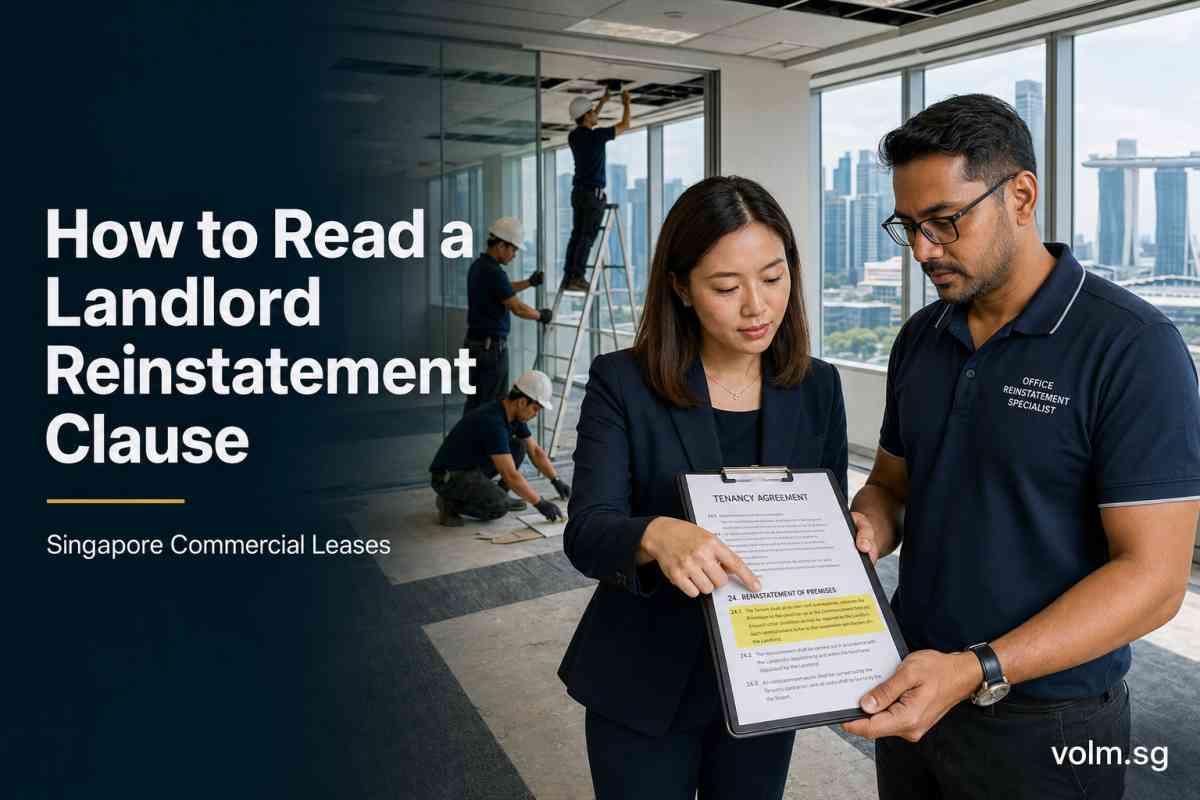
A reinstatement clause is the part of your commercial lease that spells out exactly what you must do to the premises before handing them back.
To read a landlord reinstatement clause, check every lease section that sets out your duty to restore the unit to its original condition, remove alterations, make repairs, and note what costs the landlord can recover if you do not comply.
Reading it correctly—ideally before signing and again well before your lease ends—helps you plan exit costs, avoid deposit disputes, protect your security deposit, and pass the landlord's final inspection without surprises.
For commercial tenants in Singapore, as well as landlords and other parties involved in lease handover, this means knowing not just what the clause says but how it works in practice.
This guide explains what a landlord reinstatement clause is, how to find and interpret it in a tenancy agreement, the key terms to watch, how timing and inspection planning affect handover, the common mistakes that lead to disputes or delay, and where a contractor like VOLM can help you meet the lease requirements and keep your business move-out on schedule.
A reinstatement clause is a contractual obligation requiring the tenant to return the premises to an agreed condition at the end of the lease.
Reinstatement restores a property to its original condition, and the clause determines what the landlord can charge for if the work is not done. Here are the essentials to keep in mind:
The reinstatement clause sets out exactly what reinstatement works you must complete at lease end and what the landlord may deduct from your security deposit if they are not finished.
Reinstatement obligations are often spread across several sections of the tenancy agreement-yielding up, alterations, repairs-so the clause must be read together with the rest of the lease agreement.
Early reading (ideally before signing and at least three to six months before lease expiry) helps avoid unnecessary costs, failed final inspections and deposit deductions.
An experienced reinstatement contractor such as VOLM can translate clause wording into a practical, itemised scope of works aligned with landlord expectations.
A reinstatement clause is the reinstatement provision within a commercial lease or tenancy agreement that requires the tenant to return the premises to the agreed handover or original condition at the end of the lease.
The reinstatement obligation depends entirely on the wording of the lease agreement-there is no separate statutory "make good" requirement in Singapore.
In practice, reinstatement typically includes removing fixtures, repairing damage, repainting walls, restoring building services to the agreed baseline, and clearing all tenant belongings.
Some clauses are brief ("reinstate to original condition"), while others attach detailed schedules and plans. Tenants must restore the property to its original condition as described in the contract.
If the tenant does not comply, the landlord may organise the reinstatement works and recover costs-often by deducting from the security deposit, or in more serious cases, pursuing legal action.
Understanding the reinstatement clause at the outset of the lease also helps you design fit-outs that are practical and not excessively expensive to remove later, which is a point many tenants overlook during the excitement of moving in.
The wording of your reinstatement clause directly affects three business outcomes: total exit cost, timeline before handover, and how much of your deposit is realistically recoverable.
For many Singapore offices and shops, reinstatement costs can be one of the largest end-of-lease expenses-particularly where extensive partitions, M&E systems and feature finishes were added during the lease period.
Landlords may prefer properties to be returned to their original condition, and the clause gives them a contractual basis to insist on it.
Vague or misunderstood reinstatement obligations can lead to unexpected variation orders, failed inspections, additional rent liability if the unit is not accepted on time, and disputes over whether partial works are acceptable. Failure to comply with reinstatement terms can also lead to legal action by the landlord.
The clause also affects business continuity. You need to sequence reinstatement works around move-out, IT relocation, and staff operations to avoid downtime and double-renting.
Landlords, managing agents and building management will refer back to the written reinstatement provision-not verbal agreements-so early clarity is essential.
Reinstatement obligations are rarely found in a single clause. They are typically scattered across different sections of a commercial lease, supplemental agreements and any licence for alterations carried out during the tenancy.
Look for headings such as "Yield Up," "Reinstatement," "Alterations and Additions," "Tenant's Works," "Make Good" and "End of Lease Handover."
Gather all relevant documents: the main lease, supplemental agreements, licences for alterations, landlord-approved space plans, and any written reinstatement notice issued close to lease expiry.
A Schedule of Condition is particularly beneficial for verifying pre-existing conditions of the premises-if one was prepared at the start of your tenancy, it becomes your reference point.
Read each relevant clause slowly and underline concrete requirements: "remove," "demolish," "reinstate," "to landlord's reasonable satisfaction," and specific references to paint colours, flooring types or ceiling systems.
Commercial tenants should review the reinstatement provisions jointly with both their reinstatement contractor and, where appropriate, legal counsel, so that each sentence translates into a clear physical scope of works carried out on site.
Key components of reinstatement clauses include the definition of the original condition and the scope of the required works. Here is a practical guide to common phrases and what they typically require:
"Original condition" or "base building condition" generally refers to the state recorded at the start of the lease-photos, schedule of condition, bare or partially fitted unit-rather than a brand-new upgrade.
It may reference specific ceiling heights, a lighting grid and base flooring. Reinstatement typically includes removing fixtures and restoring the layout to its original state.
The distinction between "To the landlord's satisfaction" and "to the landlord's reasonable satisfaction" is important. The latter gives the tenant more protection because the landlord's requirements must be commercially and technically reasonable, not arbitrary.
"Fair wear and tear excepted" means tenants usually do not need to renew items simply because they have aged under normal use. However, damage from unauthorised drilling or non-standard finishes typically falls outside this exception.
"Removal of tenant's fixtures and fittings" and "works carried out during the lease term" cover cabling, partitions, signage, feature lighting, pantries and additional power points.
These are treated as tenant works that must be removed unless otherwise agreed. "Make good" obligations often require repairing any damage caused by the removal of these installations.
Retail reinstatement often requires removing shop signage and display racks. F&B reinstatement includes dismantling kitchen equipment and plumbing works.
Some clauses let the landlord elect, via written notice, to retain certain alterations-for example, glass partitions-while still requiring removal of the rest. This is sometimes referred to as partial works or a landlord retention option.
Not all commercial leases require the landlord to issue a separate reinstatement notice. In some cases, the obligation to reinstate alterations is automatic at the end of the lease.
In others, the lease terms state that reinstatement is required only "if and to the extent the landlord so notifies," and some leases require landlords to give three months' notice for reinstatement.
Where a reinstatement notice is required-for example, three or six months before lease expiry-it should specify which alterations must be removed, any improvements the landlord wants to retain, and the deadline for completion before final inspection.
Landlord discretion can affect which alterations remain after the lease period ends, so the notice serves as your confirmation of scope.
If the clause includes a notice deadline, diarise it. Late or missing notices may, in some situations, limit the landlord's ability to demand full reinstatement of past alterations.
Upon receiving a notice, immediately compare it with the original clause and any licences for alterations, and clarify any discrepancies in writing.
From a practical standpoint, VOLM can walk the unit with the reinstatement notice in hand and translate it into a phased scope and programme that fits the remaining lease term.
This is the step where dense legal wording becomes a work list that your contractor, building management and landlord can all understand and sign off on.
The recommended process is straightforward:
Collect baseline information - original handover photos, plans, and any schedules attached to the lease.
Mark up what alterations were carried out during the tenancy: partitions, cabinetry, cabling, plumbing works, and additional lighting.
Overlay the reinstatement clause to identify every item that must be removed or made good.
Separate your lease obligations into clear work packages: demolition and partition removal, M&E and cabling removal, reinstatement of ceilings and floors, repainting and finishing, signage removal, cleaning and waste disposal.
Reinstatement works often include removing partitions and fixtures, restoring flooring and ceilings, and may involve dismantling electrical and mechanical systems.
Note that some clauses may require landlord approval for reinstatement plans and vendor selections.
A joint pre-works inspection with the landlord or managing agent is valuable-use the reinstatement provision as a checklist to confirm what "good enough" looks like before committing to cost and schedule.
As a reinstatement contractor, VOLM can provide itemised quotations for each clause-driven obligation, so commercial tenants know where most of the cost and time will fall.
Reading the clause correctly is only half the challenge. You also need to plan timing and inspections so that the landlord accepts the works at the first attempt.
Start reinstatement planning at least two to three months before lease end-ideally earlier for larger or more complex premises. Allow time for the design of reinstatement works, building management submissions, quotation comparison, and scheduling.
Timelines for reinstatement work are crucial and may incur penalties for delays beyond the lease expiration.
The lease term, access hours, building rules (night work only, restricted drilling times), and any required regulatory approvals, such as fire safety compliance for sprinklers and emergency lighting, can extend the actual time needed on site.
Plan a pre-final inspection walkthrough with your contractor, using the reinstatement provision as a checklist, followed by the official landlord or managing agent final inspection that determines whether the security deposit can be released.
Tenants may face penalties for failing to comply with reinstatement terms on time, including continued rent liability.
Common pitfalls to avoid:
Assuming partial works will be accepted without written approval
Misreading the reinstatement clause, which can lead to unexpected costs
Skipping a joint site inspection, which can cause disputes over original conditions
Ignoring M&E systems, which can result in failed final inspections
Hiring unlicensed contractors, which can lead to non-compliant work and liability issues
Relying on verbal relaxations of the clause that are not documented in accordance with the lease
VOLM is a Singapore-based renovation and reinstatement contractor that focuses on translating lease obligations into practical project scopes.
The company does not provide legal advice-its role is to help you understand what the clause means in physical terms and to plan, price and deliver the work.
VOLM typically approaches a new enquiry by reviewing the client's reinstatement clause, any landlord reinstatement notice, and the current floor plan, then conducting a site assessment to map written obligations onto the actual premises.
From there, VOLM can prepare an itemised reinstatement proposal that aligns with the lease terms, distinguishing between mandatory reinstatement works and optional improvements the tenant may choose to leave untouched if the landlord agrees.
VOLM is familiar with common reinstatement requirements of office towers, business parks and retail malls-including building-management submissions, method statements, risk assessments, and typical final inspection expectations.
To get started, share your:
Premises type and size
Building location
Target completion or handover date
Floor plan or landlord checklist, if available
This allows VOLM to advise on scope, sequencing and next steps before your lease ends.