
close
close
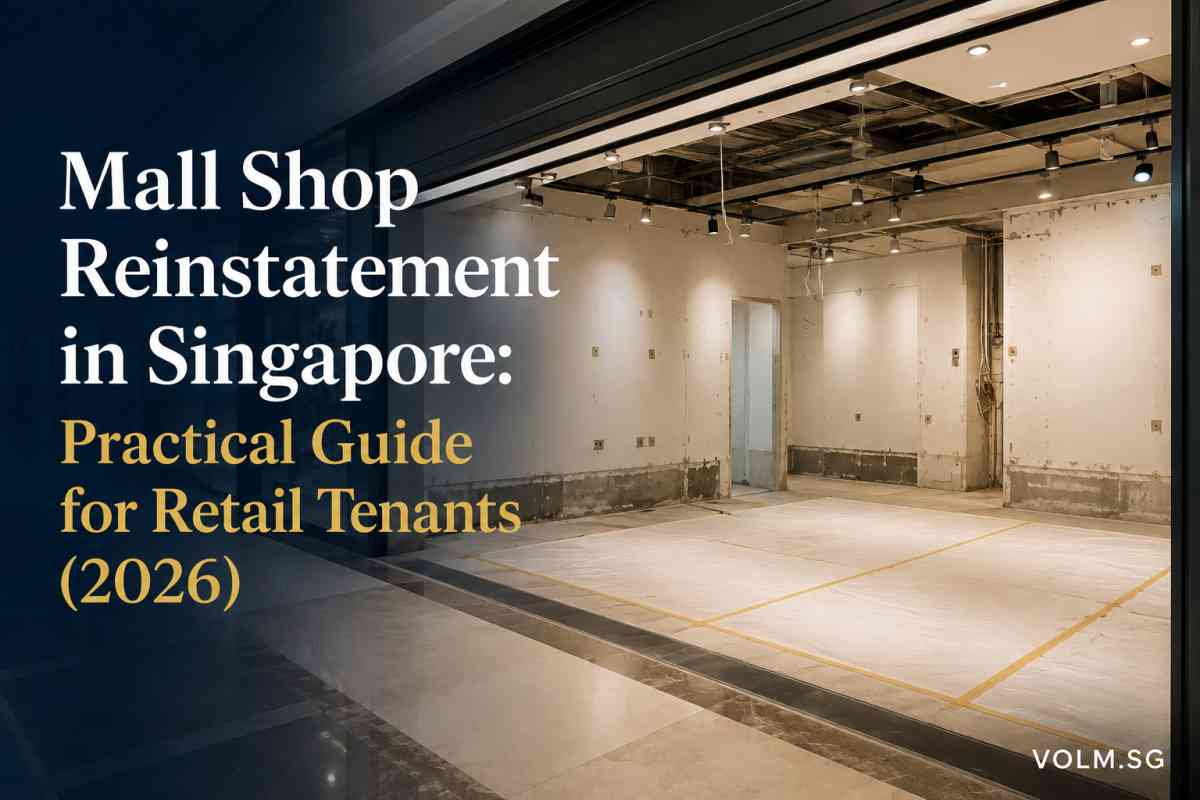
Mall shop reinstatement is the process of restoring a retail unit in a Singapore shopping mall to its original handover condition, as required by the reinstatement clause in the lease agreement. Shop reinstatement restores a retail unit to its original condition - and retail reinstatement restores units to original condition per lease, making this a contractual obligation rather than an optional tidy-up.
The reinstatement process typically includes dismantling fit-outs, removing partition walls, restoring false ceilings, flooring systems, and wall surfaces, disconnecting electrical systems and mechanical systems, performing thorough cleaning, and then passing the landlord's final inspection. Proper reinstatement directly affects your security deposit recovery, potential lease-end penalties, and whether the shop unit can hand over on time.
VOLM supports retail tenants from the first free site inspection through to final handover coordination, but does not guarantee landlord approval or deposit return - those outcomes depend on the tenancy agreement, the landlord's standards, and the condition of the unit at handover.
Mall shop reinstatement carries real business risk. Security deposits in retail leases typically represent two to three months' rent. Security deposits may be at risk if reinstatement is not executed satisfactorily. Add lease overrun rent and potential disputes with major mall landlords, and a poorly managed handover can become an expensive problem for retail businesses.
Retail shop reinstatement is not the same as simply moving out. It is a contractual construction project with safety, waste disposal, and compliance requirements. The reinstatement process requires adhering to mall operational rules, including noise restrictions, and reinstatement must comply with landlord specifications and timelines - not just your own schedule.
Common pain points include short reinstatement windows of seven to fourteen days after lease expiry, after-hours work restrictions in trading malls, and strict mall management inspections that can reject incomplete works. For franchise or group retailers operating across multiple shopping mall locations, consistent reinstatement quality also protects brand reputation and future tenancy relationships.
By comparison, office reinstatement is usually simpler than retail reinstatement in enclosed mall units, as offices typically involve fewer custom shopfront fixtures, display lighting, and wet works such as kitchen exhaust or grease traps.
The reinstatement clause is a section in your tenancy agreement defining exactly how the retail unit must be returned at lease expiry. Reviewing the lease agreement is essential for understanding reinstatement requirements - and not reviewing the lease agreement can result in compliance issues later.
Common wording includes "reinstate," "restore," "make good," "original condition," and "bare unit." In practical terms, "make good" usually means repairing damage caused by your fit-out works. "Original condition" typically means returning the unit to base-build state. "Bare unit" implies minimal fixtures and no decorative finishes.
For mall units in Singapore, "original condition" usually means bare concrete or screed floor, base-coat plastered walls, no false ceiling (or the landlord's original ceiling grid), and all M&E points capped at their initial positions. Reinstatement must follow specific technical guidelines set by landlords, and compliance with landlord specifications is mandatory for reinstatement.
Fair wear and tear generally covers minor surface ageing - small scuffs, faded paint, slight carpet wear. It does not cover tenant-installed partitions, raised platforms, lighting systems, plumbing systems, or kitchen systems.
To determine the exact scope, compare your lease, the mall's tenant handbook, and your original handover report. Documentation of original fit-out conditions is necessary for proper reinstatement. Review your tenancy agreement for reinstatement clauses before starting any planning. VOLM can help interpret scope but does not offer legal advice.
The reinstatement scope is the agreed list of reinstatement works needed to satisfy landlord requirements and pass the final inspection. The exact reinstatement scope varies by unit type, initial fit-out complexity, and what was documented at tenancy start.
Common architectural works include dismantling fixtures and removing partitions, removing custom joinery and display counters, taking down shopfront glazing and signage, hacking decorative tiles or vinyl back to screed, patching and replastering walls, and repainting to neutral base colours. Dismantling tenant-installed fixtures is required during reinstatement, and this usually requires certified contractors familiar with mall regulations.
Electrical reinstatement typically involves removing tenant-installed light fittings, power points, signage wiring, and data cabling, then capping circuits at the landlord's original points. For beverage outlets and F&B units, the scope extends to removing exhaust hoods, grease traps, plumbing fixtures, and gas lines.
Tenants may need to restore fire safety systems during reinstatement, including sprinkler heads or fire alarm configurations modified during fit-out. All electrical and fire protection work must be carried out by licensed specialists.
Reinstatement in a mall or commercial building is governed not only by the lease but also by building management requirements and external authorities. Tenants should anticipate these early to avoid delays.
VOLM helps clients interpret landlord checklists, sequence approvals and incorporate regulatory lead times into the programme so that the final inspection and lease handover proceed without last-minute surprises.
Support tasks round out the scope: install protective measures for common area corridors and floors, handle debris through approved routes, arrange NEA-compliant waste disposal, and complete professional site cleaning before the landlord inspection. Costs for reinstatement generally include demolition, electrical works, and cleaning.
The reinstatement scope for a retail shop, F&B outlet, or kiosk will differ depending on what was built during fit-out and what your original handover report documents.
Retail spaces in malls, street-front shophouse units, and commercial units in office buildings all require reinstatement at lease end, but they differ meaningfully in complexity and constraints.
Shopping mall reinstatement involves stricter approved working hours - often limited to between 10 pm and 8 am - mandatory hoarding, loading bay bookings, and the constant need to keep public areas clean and safe for shoppers. Mall management controls are more rigorous than most commercial buildings.
Compared to office reinstatement, retail reinstatement typically involves additional elements: custom shopfronts, branded façades, display lighting, feature ceilings, and heavier M&E loads (particularly for F&B). Office units rarely require shopfront removal or kitchen dismantling works.
Shophouse units may offer more flexible working hours and simpler building management approval processes, but tenants must still comply with URA guidelines and relevant building regulations.
The practical implication: shop reinstatement in Singapore mall environments usually demands a higher budget, a tighter project schedule, and an experienced contractor familiar with mall management procedures and landlord requirements.
Start planning three to six months before lease expiry - not when the notice to vacate arrives. Early reinstatement planning should begin two to three months before lease expiry at a minimum, and ideally earlier for larger or more complex units. Tenants should start reinstatement planning 3 to 6 months before lease ends to allow adequate lead time.
8–10 weeks before lease end: Re-read the reinstatement clause, request the original handover report from your landlord, gather approved fit-out drawings, and shortlist a shop reinstatement contractor. Engage a contractor early to avoid project delays and limited contractor availability.
4–6 weeks before: Confirm scope and quotation, lock in project dates, obtain mall management guidelines, and prepare a method statement and permit submissions. Timely communication with landlords about reinstatement expectations can prevent issues at this stage.
1–3 weeks before: Remove loose fixtures, clear stock, and stage reinstatement work by area. Agree joint inspection dates with the landlord or centre management. Some malls allow reinstatement during the final trading days behind hoarding, which can reduce lease-overrun risk but requires careful coordination.
Starting reinstatement work too late causes scheduling challenges. Late starts typically result in urgency premiums, limited contractor availability, and a higher risk of missing the handover deadline. Poor planning can significantly increase reinstatement costs, and fines may be imposed for late reinstatement completion.
The retail shop reinstatement process is broadly similar across Singapore malls, though details vary by landlord and building. Below is the approach VOLM typically follows for shop reinstatement projects in Singapore.
Step 1 - Site inspection. A joint walk-through compares the unit's current condition against the original handover report and lease obligations. Every area - walls, floors, ceilings, shopfront, M&E points - is photographed and documented to establish the reinstatement scope.
Step 2 - Scope and quotation. The site inspection findings are translated into an itemised quotation covering demolition, M&E disconnection, architectural finishes, and cleaning. Provisional sums are noted for any unknowns, such as concealed wiring or hidden damage.
Step 3 - Approvals and scheduling. VOLM prepares a method statement, risk assessments, and drawings if required, then submits these to mall management. Working hours, loading bay times, and hoarding requirements are confirmed. Necessary permits must often be filed with mall management before work commences.
Step 4 - Protection, dismantling and reinstatement work. Hoarding installation is often mandatory to protect common areas during reinstatement. Floor protection is laid along common corridors. Dismantling works proceed in approved time slots: stripping partitions, removing shopfront features, disconnecting electrical and mechanical services, hacking floor finishes, patching walls, repainting, and reinstating ceiling conditions.
Step 5 - Waste disposal and cleaning. All construction waste and debris are removed by NEA-licensed waste collectors. Proper disposal of debris is a legal requirement in the reinstatement process. Common areas are kept clean throughout. Final cleaning is essential before the landlord's inspection - a thorough cleaning of the entire unit is carried out before scheduling the handover.
Step 6 - Internal checks and final inspection. VOLM conducts an internal snag check, then arranges a joint inspection with the landlord or mall management. Final joint inspections with landlords are conducted to verify compliance before handover. Any remaining items are rectified promptly, and keys are returned only after written sign-off is obtained. This completes the final handover.
Reinstatement prices are highly project-specific, and VOLM does not publish fixed rates or guarantee final costs. Retail shop reinstatement cost depends on several interconnected factors, so rough online figures should be treated as starting points only.
Main cost drivers:
| Factor | Impact on cost |
|---|---|
| Unit floor area | Larger units require more labour, materials, and time |
| Fit-out complexity (dry retail vs heavy F&B) | F&B units with exhaust, grease traps, and plumbing systems cost more |
| Base-build condition required | Full shell restoration costs more than partial strip-out |
| After-hours work premiums | Typically 30–50% above standard rates |
| Hoarding, insurance, and renovation deposits | Mall-specific requirements add to overheads |
Costs vary based on unit size and previous renovations. Reinstatement costs in Singapore range from S$5,000 to S$15,000 for many typical retail units, though larger or heavily fitted-out spaces - particularly F&B - can exceed this.
Reinstatement costs are influenced by compliance with landlord specifications and the extent of "making good" required. Hidden costs may arise from building requirements and unexpected changes, such as concealed wiring or undocumented structural modifications.
Time drivers: Reinstatement projects generally need 7 to 14 days for completion, restricted to certain hours. Permit approval times from mall management, access to after-hours work slots, loading bay availability, and coordination with licensed trades for electrical and fire protection works all influence the programme. To avoid unexpected expenses, arrange a site inspection for an itemised estimate rather than relying solely on per-square-foot benchmarks.
Clear scope definition upfront is the most effective way to control variation orders and unexpected expenses during completing reinstatement.
Non-compliant works can be stopped by mall management or regulators, delaying handover and potentially incurring penalties. Failure to comply with reinstatement guidelines may incur penalties beyond just deposit deductions.
Key Singapore regulatory requirements (in plain terms):
Typical mall requirements: Many landlords maintain lists of approved contractors and require bizSAFE certification or equivalent safety standards. Method statements, risk assessments, and contractor insurance certificates (public liability, workmen's compensation) must usually be submitted before work begins.
Safe dismantling practices include isolating electrical circuits and using licensed electrical workers, protecting sprinkler heads and fire alarms from damage, and applying fall-protection measures for signage removal at height.
Waste disposal expectations: Debris must be segregated where possible, in line with NEA's 3R Guidebook for Shopping Malls. Loading bays must be kept clear, and dust or noise nuisances during mall trading hours must be minimised.
VOLM plans reinstatement work to minimise disruption to neighbouring tenants and customers, but actual working-hour constraints are set by building management.
Most reinstatement problems stem from late reinstatement planning or misunderstanding lease obligations, not from technical complexity. Choosing the wrong contractor can lead to project delays, and underestimating reinstatement scope leads to unexpected delays.
Mistake 1 - Assuming the next tenant's renovation removes the need for reinstatement. Landlords can still enforce full reinstatement unless they confirm a waiver in writing. Never rely on verbal assurances.
Mistake 2 - Under-scoping works. Focusing only on demolition and skipping "making good" items such as floor screed, wall plastering, and repainting often leads to a failed landlord inspection. The reinstatement scope must match the lease, not just what seems visually obvious.
Mistake 3 - Engaging a general renovation contractor unfamiliar with mall rules. This frequently results in rejected works, stop-work notices, or non-compliance with fire safety and electrical standards. Select a contractor with in-house specialists for efficiency, and choose one familiar with landlord requirements.
Mistake 4 - Not documenting pre-reinstatement conditions. Without photographic records and the original handover report, tenants are exposed to claims for pre-existing damage they did not cause.
Mistake 5 - Handing back keys before obtaining written sign-off. This reduces leverage in any security deposit discussions. Always obtain a formal defect list or acceptance letter before returning keys.
Practical tips: Start at least eight weeks early with proper planning, insist on written scope confirmation, request handover condition records, and maintain a clear email trail with the landlord and mall management to prevent unnecessary delays.
VOLM is a Singapore commercial reinstatement contractor experienced in office, retail shop, and mall units. Our focus is on clear scope definition, practical scheduling, and coordinated execution across reinstatement projects of varying size and complexity.
For retail shop reinstatement projects, VOLM typically provides an initial site inspection, compares the unit's condition against reinstatement obligations, prepares an itemised reinstatement scope, and coordinates trades from strip-out through to final touch-ups.
We assist with building management submissions, method statements, and practical scheduling - but landlord approval, final inspection outcomes, and deposit decisions remain with landlords and the relevant authorities.
If you are approaching lease expiry on a mall retail unit, share the following details so we can offer a more accurate view of your reinstatement scope and likely timeframes:
With this information, VOLM can outline the next practical steps to prepare for a smooth handover. Whether you are managing a single retail shop reinstatement services engagement or coordinating shop reinstatement Singapore projects across several locations, clarity and early planning consistently produce better outcomes than rushing for the lowest quotation.
A typical shop reinstatement project covers strip-out of partitions and custom fixtures, M&E disconnection and capping, removal of floor and wall finishes back to base condition, ceiling reinstatement, and thorough end-of-works cleaning. The reinstatement clause in your lease and the original handover report are the definitive references for what your reinstatement in Singapore must cover.
Small units under 500 square feet may take five to ten working days. Medium-sized retail units typically require ten to fourteen days. Larger or F&B-heavy spaces can take up to three weeks. Mall permit approvals and after-hours restrictions often affect timing more than the physical work itself.
Some landlords may agree to keep certain works - for instance, if the next tenant plans a similar fit-out. However, any waiver must be documented in writing before you plan the shop reinstatement project. Verbal agreements offer no protection.
Mall management usually requires reinstatement permits, along with method statements and insurance documentation. Electrical, fire protection, and structural works may trigger additional authority notifications, handled by licensed specialists through the reinstatement contractor.
Renovation fits out a space for trade; reinstatement reverses those works to restore the unit to its original condition. Both phases require landlord approval and mall management submissions. Understanding this distinction helps with reinstatement planning and budgeting for completed reinstatement projects.
The landlord typically holds the security deposit until reinstatement works are accepted. A recent High Court decision noted that a security deposit is repayable within one month from reinstatement works being completed and accepted by the landlord. Completing reinstatement to the required standard is therefore directly linked to deposit recovery.