
close
close
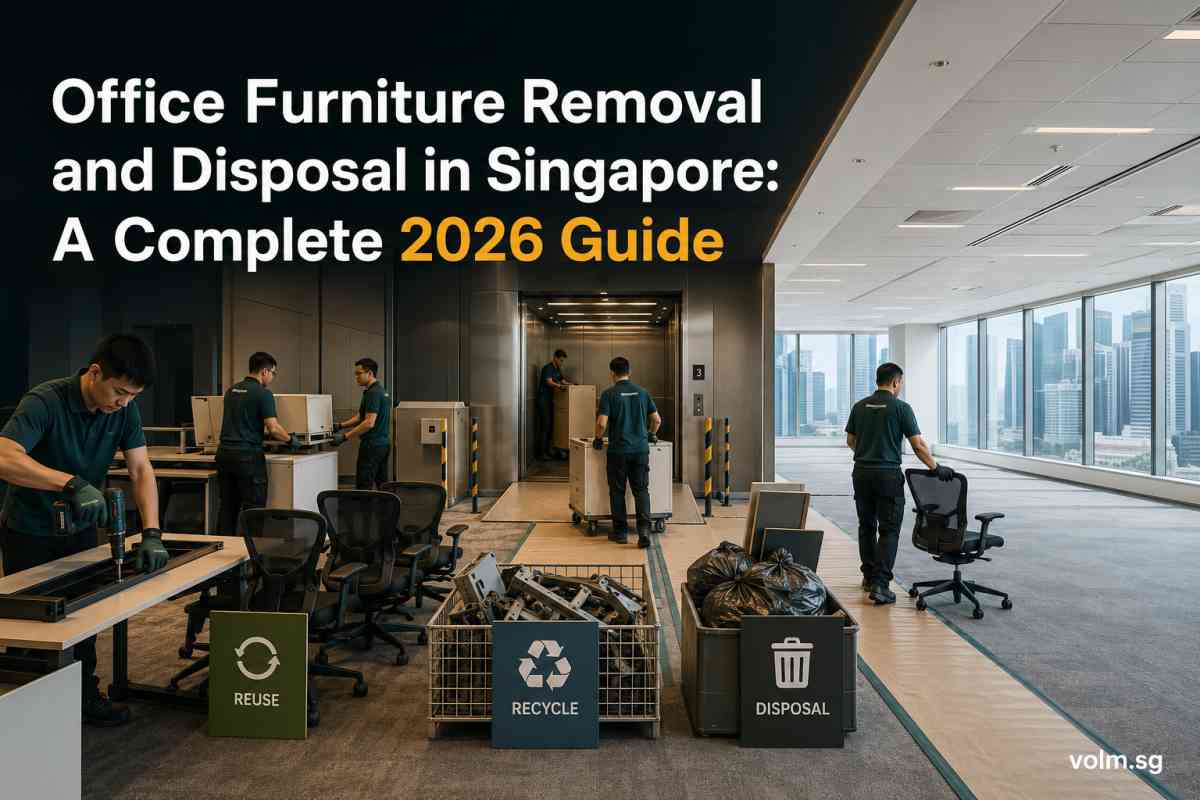
Office furniture removal and disposal in Singapore involves far more than calling a truck. It requires planning for building access, bulky item removal, lease handover deadlines, after-hours work restrictions, and compliance with landlord, MCST, and regulatory requirements.
This complete guide walks through what the disposal process covers, what drives cost and timing, and how to avoid the mistakes that lead to emergency surcharges or forfeited deposits.
Office furniture removal and disposal in Singapore covers the planning, dismantling, carrying out and legally disposing of office desks, workstations, chairs, cabinets, partitions and other commercial items from offices and workplaces. The service usually supports move-outs, reinstatement works, renovations, downsizing, or full office closure, rather than ad hoc single-item collections.
Office furniture removal services in Singapore offer solutions for relocation and renovations, including dismantling, heavy lifting, transport, and responsible disposal of office items.
A few related terms are worth clarifying:
Office disposal or clearance may include built-in fixtures as well as loose furniture.
Furniture disposal typically focuses on movable items such as chairs, desks and pedestals.
Comprehensive disposal services bundle removal into broader reinstatement to meet landlord expectations.
VOLM approaches this as part of a coordinated project workflow - connecting disposal needs with reinstatement, fit-out and handover milestones - rather than treating it as a basic junk removal run.
Lease expiry dates, reinstatement clauses and security deposits typically drive office disposal timelines in Singapore's CBD and fringe business districts.
Most commercial leases require tenants to return premises to bare or original condition, which means removing all old furniture, fixtures and signage before landlord inspection.
Leaving bulky furniture or construction debris behind can result in landlord back-charges, forfeited deposits or additional removal arranged by the building at a premium.
Poor scheduling affects business operations directly. Attempting to clear large volumes of old office furniture during core hours - without coordination - can disrupt operations, call centres or trading desks.
Professional disposal services handle bulky office furniture efficiently and can offer same-day collection for urgent removals.
From a legal perspective, improper disposal can result in fines up to SGD 50,000. Businesses are encouraged to donate functional furniture to local charities or organisations, prioritising reuse over recycling and disposal in line with sustainable practices. Eco-friendly disposal protects your corporate reputation and supports ESG commitments.
Data and asset security is another concern. Cabinets holding confidential documents, hard drives or branded fixtures must follow a controlled chain of custody. Discarding these without oversight creates legal and reputational exposure.
The scope for a typical office disposal service includes a wide range of items:
| Category | Examples |
|---|---|
| Loose furniture | Workstations, height-adjustable desks, task chairs, executive chairs, pedestals, mobile caddies, meeting tables |
| Storage | Steel cabinets, compactus units, lockers, loose shelving |
| Common areas | Reception counters, pantry tables, whiteboards, notice boards |
| Semi-fixed items | Glass partitions, loose carpet tiles, obsolete signage, small storage racks |
Office furniture disposal often requires dismantling bulky items. Large furniture, such as boardroom tables, compactus systems, and tall cabinets, typically needs to be taken apart before it fits into service lifts and loading bays. Bulky item removal is a core part of any commercial project.
Furniture often contains recyclable materials that should be separated for appropriate recycling streams. Ideally, furniture should be disassembled into components such as metal, wood, and plastic for proper recycling.
Related materials may require special handling: confidential documents in cabinets require secure shredding; IT racks (excluding server decommissioning) may require specialist partners; and electronic items must be disposed of as e-waste through designated recycling channels. Branded fixtures that should not appear on secondary markets must be destroyed.
A clear schedule of items - supported by photos or a simple inventory spreadsheet - is the basis for any serious quotation. The more precise the scope, the more accurate the quote and the lower the risk of variation orders.
There is no meaningful "per square foot" rate for office furniture disposal. Instead, costs are shaped by several practical factors:
Volume and complexity: Number of workstations, cabinets and meeting rooms, whether items are loose or fixed, and presence of bespoke joinery or glass elements. Limited disposal options exist for large volumes of office furniture through standard building waste streams, so engaging licensed waste collectors is important for such disposal.
Building access: Service lift capacity, loading bay access distance, requirement for lift protection (padding, plywood), security sign-ins and whether works are permitted only after hours or on weekends. Loading bay access and lift access restrictions directly affect crew size and scheduling.
Manpower and removal vehicles: More storeys, heavier furniture and tighter deadlines usually mean larger crews, more lorry trips or larger removal vehicles.
After-hours and weekend work: Many Grade A corporate offices in Raffles Place, Marina Bay, and one-north permit bulk removal only after 7 pm or on Saturdays. Shift allowances and extended supervision add cost but may be necessary to avoid disruption to neighbouring tenants.
Disposal route: Whether usable furniture can be donated, sent for recycling or must go to disposal facilities.
Professional disposal services start from SGD 80 for small loads, but commercial projects with fixed quotes covering dismantling, transport and disposal are typically higher. Same-day office furniture disposal is available in Singapore for urgent situations, though this commands a premium.
Treat any phone quote without a site visit or photos as indicative only. Contingency is usually lower when detailed information - including photos, floor plans and a landlord checklist - is supplied upfront.
Here is a practical six-step workflow that a facilities manager, office manager or project lead can expect when engaging VOLM or a similar commercially minded provider.
Step 1 – Initial briefing. The client shares the floor area, address, photos or videos of the office, basic furniture counts, and the target completion or landlord inspection date. You can send photos via email or messaging apps to speed this up.
Step 2 – Building rule check. The contractor reviews MCST or landlord requirements, including building access rules, lift booking, allowed hours, noise restrictions, security clearance, escort needs and any documentation for NEA-licensed disposal facilities.
Step 3 – Scope separation. Items are tagged or clearly marked: furniture for disposal, items to be relocated to a new office, assets for temporary storage, and confidential documents requiring secure destruction. Donating items to charities or social enterprises is considered at this stage for suitable pieces.
Step 4 – Quotation and schedule. A commercial quote will detail manpower assumptions, vehicle runs, dismantling allowances, protection materials and estimated disposal tonnage. Working windows are proposed around building access hours and the client's business continuity needs.
Step 5 – Site execution. The operations team arrives with a safety briefing, installs floor and lift protection, and carries out systematic removal of bulky furniture. The team works quickly but carefully, ensuring proper handling and safe and efficient removal. Where buildings require it, work proceeds after hours with supervision.
Step 6 – Final check and basic tidy. The team ensures a joint walkthrough with the client or representative, confirming that agreed furniture is removed, common areas are left tidy and the space is ready for the next trade or landlord inspection.
Reputable services provide documentation for proper disposal compliance. Companies can document disposal quantities for environmental reporting and compliance.
Commercial towers, business parks and industrial properties each have distinct approval processes. Ignoring these often causes project delays and variation orders.
Building access and logistics. Office disposal requires adherence to strict building access rules. Security passes, pre-registration of workers, service corridor routes and dock levellers at loading bays are common requirements.
Many buildings require protective materials in lobbies and lifts. Building management must be coordinated for disposal permits and access; failing to do so can halt work upon arrival.
MCST and landlord approvals. Grade A developments and integrated mixed-use complexes may require method statements, insurance certificates, and work schedules before any removal is permitted. These approvals can take one to two weeks, so early engagement is essential.
Regulatory compliance. The National Environment Agency oversees waste management regulations in Singapore. Bulky furniture must be taken to approved disposal facilities by licensed collectors. Illegal dumping can result in fines up to SGD 50,000.
Office furniture disposal services often include recycling options, and responsible disposal practices support NEA's 3R programme, which documented a case in which 50 office items were redeployed to NGOs, saving approximately 2,000 kg of waste.
Confidential materials. Many commercial clients and corporate offices require secure shredding or controlled destruction certificates for confidential documents and branded fixtures. These may be provided by specialised partners rather than the furniture disposal crew itself.
Workplace safety. Proper lifting techniques, PPE and clear access routes reduce risk of injury and damage to common facilities. This is why reputable contractors insist on planning rather than ad-hoc removals.
Tight timelines often complicate office furniture disposal processes. Here are the errors we see most frequently and how to reduce them:
Leaving decisions too late. Many tenants only engage contractors four to six weeks before lease expiry. Planning should start three to six months ahead for complex sites. Last-minute engagement typically means emergency surcharges and fewer service options.
Underestimating volume. Assuming all furniture is loose and small, and overlooking built-in joinery, fixed workstations, and partitions. A walkthrough or photos clarify the true scope.
Access oversights. Forgetting to book service lifts, not checking loading bay height for larger lorries, or scheduling removal during building blackout periods such as weekday lunch hours. Lift booking and security clearance need to be arranged well in advance.
Scope confusion. Failing to separate unwanted furniture from items for relocation or storage results in accidental removal or last-minute changes that disrupt sequencing and inflate cost.
Data and brand risks. Disposing of cabinets still holding confidential documents or branded fixtures that should be destroyed rather than appearing on secondary markets. Ensuring compliance with data security obligations is non-negotiable.
Practical countermeasures:
Simple colour-tagging of unwanted items versus retained items
Early engagement of building management
A shared checklist accessible to all parties
Aligning disposal dates with reinstatement and IT decommissioning milestones
A calm, step-by-step approach keeps projects within agreed cost ranges and avoids emergency surcharges.
VOLM is a Singapore-based office and commercial renovation, fit-out and reinstatement contractor. Rather than treating disposal as an isolated activity, VOLM integrates office furniture removal into broader project planning for commercial spaces.
A typical engagement starts with a site assessment to understand not only the disposal needs but also any reinstatement, minor make-good, or new fit-out works that must be completed before lease handover. This gives the client a single coordinated schedule rather than managing multiple vendors independently.
VOLM's approach to scope clarity includes documenting furniture counts, building access conditions, the disposal-versus-relocation split, and target dates, then feeding this into a schedule coordinated with other trades, such as electricians and partition installers. The professional service covers everything from the initial brief to the final walkthrough.
Where a practical option exists, VOLM may suggest reuse, resale or redeployment of certain items to reduce commercial waste and disposal tonnage, before arranging efficient removal of remaining furniture through approved routes. Transparent pricing and detailed quotations help clients understand exactly what is included.
Ready to discuss your project? Share your premises type (CBD office, business park unit, industrial office), approximate floor area, building address, preferred completion date and any landlord checklist or reinstatement clause. VOLM will provide a no-obligation quote tailored to your disposal and reinstatement requirements.