
close
close
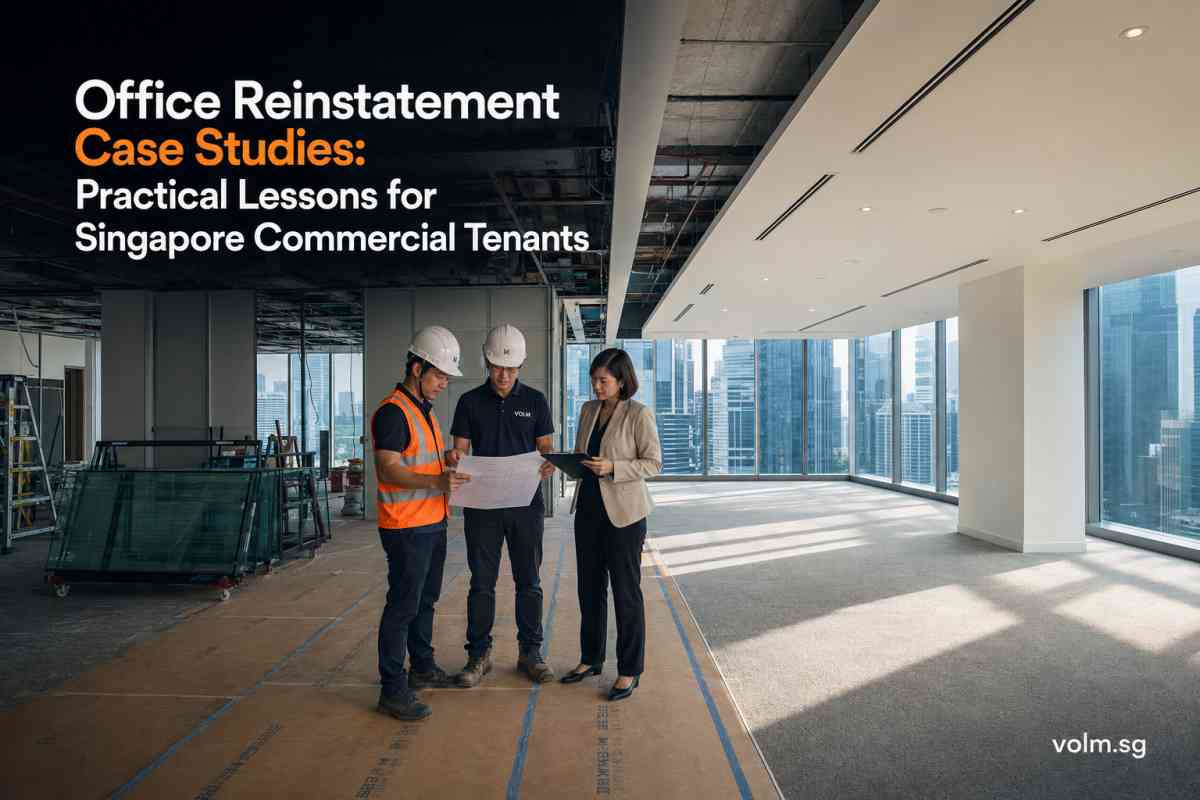
Office reinstatement case studies reveal how real tenants in Singapore managed cost, timelines, and landlord expectations when returning commercial properties to their original condition at lease end.
This article draws on practical examples from CBD offices, business parks, and co-working exits to highlight the risks of late discovery, incomplete scope, and poor coordination - and how meticulous planning with a professional reinstatement contractor prevents costly rework.
Most reinstatement problems stem from late discovery of obligations, incomplete scope definition, and poor coordination with building management - issues that surface repeatedly across CBD, business park, and co-working exit projects.
Reinstatement costs can exceed initial estimates by 20–40% when hidden services, undocumented cabling, or disputed fixtures are involved.
Failure to reinstate properly can lead to financial penalties, withheld security deposit, or legal issues under the lease agreement.
Structured planning with an experienced contractor - including early site survey, as-built documentation, and sequenced works - can save time, protect deposits, and ensure smooth final handover.
Each case study below shows specific challenges (false ceilings, hidden services, late discovery) and the practical mitigation steps that made all the difference.
Office reinstatement is the reinstatement process of returning an office space to its original condition or the landlord-required state at lease end.
Case studies show how real tenants handled timing, scope, and cost risks - offering practical data points that most tenants rarely encounter more than once every three to five years.
Typical office reinstatement works in Singapore include dismantling partitions, removing false ceilings and ceiling boards, stripping floor finishes, disconnecting additional power points, and carrying out comprehensive cleaning and repainting.
Reinstatement obligations are typically stated in the tenancy agreement, and commercial leases in Singapore typically require tenants to restore the office unit before the lease term expires.
Reinstatement costs range from S$10 to S$40+ per square foot, depending on office size, complexity, and materials used.
Because many businesses face this only once per lease cycle, learning from others' reinstatement projects reduces trial and error and helps Singapore avoid common and expensive mistakes.
A technology firm occupying a 4,200 sq ft CBD office only noticed its "bare shell" reinstatement clause in March 2025, six weeks before a 30 April lease expiry. Late reinstatement planning had created a compressed timeline with limited room for error.
The lease required the tenant to remove fixtures including glass partition walls, carpet tiles, pantry cabinets, and additional power points, and to reinstate the original suspended false ceiling and lighting layout.
Initial office reinstatement costs from contractors ranged between S$90,000 and S$110,000, with a 4–5 week programme requiring full vacancy.
VOLM's approach focused on clarifying with the landlord what truly had to be reinstated, sequencing demolition floor-by-floor, and pre-booking building management approvals to avoid weekend work surcharges.
The reinstatement works - including dismantling partitions and restoring finishes - were completed two days before the deadline. The landlord accepted minor deviations in return for thorough cleaning, and the tenant avoided holdover rent.
Practical lessons:
Review reinstatement clauses before signing any office lease, then re-check them six months before expiry
Engage a professional reinstatement contractor early to develop a precise plan
Late discovery is a common mistake that compresses timelines and inflates costs
A 6,800 sq ft office in the Raffles Place area triggered a dispute: the tenant and landlord disagreed whether LED light fittings, vinyl timber flooring, and glass meeting rooms were part of the base building or tenant fit-out.
Disputes over reinstatement scope can increase costs significantly when neither party holds clear evidence.
The landlord insisted on reinstating original 600×600 mineral fibre ceiling tiles and 300×300 porcelain tiles at the lift lobby interface.
The tenant believed the existing upgrades should stay. High-end finishes are more expensive to remove and replace, which made the financial stakes substantial.
VOLM used old handover photos, 2019 fit-out drawings, and building management correspondence to document the original state.
Through negotiation - supported by maintaining regular communication with the landlord - the parties agreed to retain high-quality lights and glass fronts if the tenant funded reinstatement of floor finishes and patch painting.
This helped maintain a positive relationship with the landlord while avoiding unnecessary demolition.
Practical lessons:
Documenting the original condition is crucial for successful office reinstatement - keep photos, approved drawings, and variation orders from day one
Use that evidence in lease-end discussions to reduce restoration works and manage landlord expectations effectively
A 3,500 sq ft multi-room office in Tai Seng had accumulated many small meeting rooms, phone booths, internal doors, and a pantry over an 8-year tenancy.
Extra power points, data cabling, and drainage were concealed above false ceilings - none documented in as-built drawings. Hidden conditions such as undocumented cabling and plumbing often complicate office reinstatement.
Unlabelled additional circuits crossed neighbouring units' zones. Careless removal could affect common systems and fail building management inspection. Hidden costs from such situations can increase total reinstatement expenses by 20–40%.
VOLM conducted an early site survey with controlled ceiling openings, tracing cabling back to distribution boards and tagging which conduits were base building versus tenant additions.
The reinstatement contractor coordinated with a licensed electrical worker (LEW) and registered plumber to safely remove only tenant-installed runs, including reinstalling power points to their original configuration and removing hollow block walls added during tenancy.
The extra 4–5 survey days added upfront meant demolition proceeded without stop-work orders or variation claims. A 10–15% budget contingency is recommended for exactly these hidden damages during any reinstatement project.
A 9,000 sq ft technology tenant in One-North was relocating in Q4 2024, with furniture disposal, server room decommissioning, workstation relocation, archive removal, and reinstatement initially overlapping chaotically.
Larger office spaces generally incur higher reinstatement costs, and coordination among multiple trades is essential for effective office reinstatement.
Concrete issues included stacked furniture blocking access for ceiling works, cabling contractors working under reinstatement teams, and cleaning teams revisiting the same zones repeatedly. Incomplete scope definition compounded delays as renovation works interfered with live IT systems.
VOLM proposed a zoned plan: Week 1 focused on clearing and reinstating back-of-house areas, Weeks 2–3 on open office zones including removing partition walls and ceiling tiles, and Week 4 on reception, server room, and final painting, with lock-out dates limiting staff access.
Coordination with IT and relocation vendors included scheduled power shutdowns, clear dates for rack removal, and dust control to protect remaining equipment.
The outcome: no accidental power cuts to live systems, a cleaner environment for the landlord's final inspection, and practical reduction in downtime.
Final inspection checks compliance with landlord requirements and building management requirements, so having a single coordination point - often the office reinstatement contractor - during termination handover is essential.
A 7,200 sq ft Marina Bay office had a neutral, open-plan fit-out with a modern pantry that was attractive to prospective commercial tenants. Full demolition seemed inefficient.
The lease still required full office reinstatement, but the landlord was informally open to retaining false ceilings, lighting grids, and some glass partitions if aligned with the new tenant's plans.
VOLM prepared a room-by-room schedule showing original condition, current condition, and what could logically remain, supported by replacement cost estimates in a formal quotation format.
A three-way negotiation followed: the landlord, outgoing tenant, and incoming tenant agreed to retain most partitions and flooring, with the outgoing tenant funding only the removal of branded elements, some power points, and repainting to a neutral base.
This reinstatement strategy delivered significant savings on demolition and disposal, reduced the reinstatement timeframe, and meant less construction noise within the building - during normal working hours, which the building management strictly enforced.
Broader lesson: under some leases, landlords may accept professional reinstatement alternatives - partial retention or cash settlement - if approached early with clear technical expertise and supporting documentation. Engaging a reliable contractor who can present these options credibly is crucial for project success.
Across CBD offices, business parks, and co-working exits, repeated patterns emerge: late review of obligations, underestimation of building management restrictions, and lack of documentation on original conditions.
Successful reinstatement projects often depend on early scope verification and coordination of tasks across all vendors.
Hidden services, false ceilings, and disputed fixtures all stem from not having clear as-built records and reinstatement criteria
Hiring a general handyman rather than the right contractor may lead to costly delays and failed compliance checks
Most tenants underestimate the administrative effort of permits, approvals, and joint inspections
Planning for office reinstatement should begin 6 to 12 months before lease expiry for larger or heavily modified spaces
Projects that succeed usually share four elements: early assessment, a realistic budget with contingency, clear division of responsibilities, and a single point of coordination for trades and inspections.
A certified contractor ensures compliance with tenancy agreements and reduces the risk of rejected handover.
Any commercial tenant in Singapore can apply these steps 4–6 months before lease expiry to build a detailed scope and reinstatement strategy:
Review your lease - identify reinstatement clauses, landlord requirements, and the standard of condition required
Gather documentation - collect all fit-out drawings, approvals, and handover photos from the start of your lease term
Walk the site - note every addition: partition walls, ceiling boards, M&E modifications, internal doors, additional power points
Check building rules - confirm working hours restrictions, lift access, waste disposal protocols, and permit requirements from building management
Obtain a detailed scope proposal - contractors should provide a detailed proposal estimating costs, programme, and how they will handle approvals, safety, and inspections. Research contractor reviews and past projects before hiring
Coordinate the exit - align reinstatement timing with IT shutdown, staff move-out, and furniture disposal to minimise double rent and disruption. Reinstatement works should begin 2–3 months before lease expiry, with planning starting earlier
Clarify in writing what the landlord will inspect, who attends the joint inspection, and how defects will be handled before final handover.
Tenants must restore offices to original condition before lease end - so a precise plan developed with an experienced contractor through professional reinstatement services is essential.
Ready to start? Share your floor plan, building address, landlord's reinstatement checklist, and target handover date with VOLM for a no-obligation site survey and a structured discussion about your office reinstatement process.